Monday, November 19, 2012

Vespucci Conference

On 22-24 November the University of Florence will host a conference on Amerigo Vespucci. Interesting papers, programme below


Sunday, October 7, 2012

The Sign of the Weeping Virgin


This is a very special post dedicated to a writer who is first a friend: Alana White. I “met” Alana virtually, she was the very first person to get in touch with me as soon as I started blogging on the Vespucci family a couple of years ago. We soon became “email friends” (can’t really say pen friends in this virtual age….) and started exchanging knowledge on the Vespucci and Renaissance Florence. I found out Alana was a short-story American novelist and that she was writing her first book with two Vespucci family members as main characters. That sounded so fascinating and I was thrilled when, a few months later, she announced that her book was going to get published…!

Here we go, The Sign of the Weeping Virgin is about to come out and I really c.a.n.n.o.t w.a.i.t to have it in my hands. What intrigues me most is the fact that, despite what one could imagine when thinking of the name “Vespucci”, her novel does not simply deal with Amerigo the explorer but also with his uncle Guido Antonio. Now, having studied the Vespucci for two years (can't believe two years are gone already!) I can assure you that nearly nobody knows who Guido Antonio is. Avid reader of Renaissance history, culture, and art books, Alana engaged with some serious research and I am curious to find out more about her work. If you want to know about Guido Antonio and follow him across the street of Florence with his nephew Amerigo do not miss out on this book. Oh yes, nearly forgot. They are investigating a fifteenth century crime,  Bring out the detective in you and get ready to solve this mystery…

Coming out in Winter 2012, it is possible to preorder a copy of The Sign of the Weeping Virgin through Amazon (hereIf in the meantime you want to know more about Alana and her novels visit her website: http://www.alanawhite.com/the_sign_of_the_weeping_virgin_112597.htm


If you have ever been to Florence or you are going to Florence, or you want to go to Florence, if you’ve ever whiled away an afternoon in company of Renaissance masters in an art museum - or if you just want a really good read filled with colour and intrigue a story peopled with characters who are at once exotic and humanly familiar in their universal lust, passions, fears, and ambitions, then this mystery, set in  Renaissance Italy, is for you. Through Alana White’s elegant prose and skillfully integrated research the 15th century City of Flowers come to life” - Brenda Rickman Vantrease author of “The Illuminator” and “The Heretic’s Wife” 

Wednesday, October 3, 2012

Events - more to come!

Yet another book on Amerigo Vespucci and the Florentine explorers. Tantalizing title ...


Sunday, September 30, 2012

Events, Events, Events!


So far 2012 has indeed been very much Vespucci-oriented (for my joy!). Many initiatives have been organized throughout Italy and, judging from what’s still to come, the Vespucci season has not finished yet.

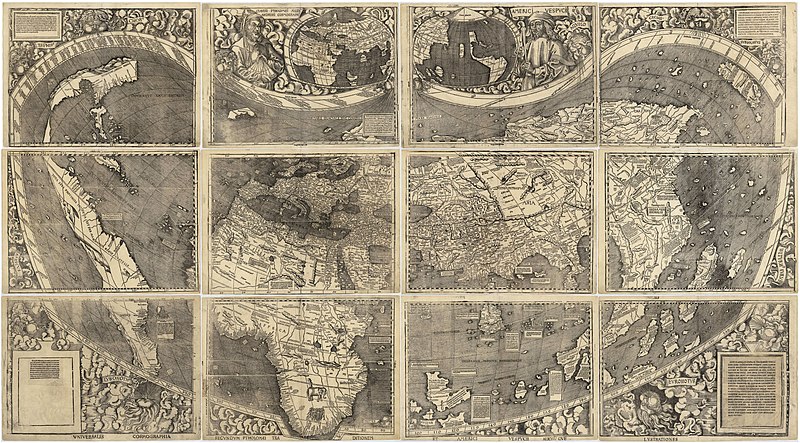
For those of you who happen to be in Florence at the beginning of October (I know, short notice I am afraid...) do not miss out on the event organized by the Comitato Amerigo Vespucci, scheduled for Wednesday 3 October. In the church of Ognissanti at 4.00 pm attendants will have the opportunity to see a life-size copy of the Waldsemuller Map, displayed next to the Vespucci chapel. The presentation of the volume I segreti delle antiche carte geografiche by Claudio Piani and Diego Baratono will follow at 5.30 pm in the Libreria de’ Servi. The book will reveal the authors’ ideas on the Waldsemuller map and its relation with the frescoed lunette of the Vespucci chapel. Piani-Baratono already developed the hypothesis that the Waldsemuller Map might be derived from the cloak of the Virgin represented in the chapel’s lunette. According to the authors, in fact, the map has the same shape of the Virgin’s mantle. This theory is now further investigated in I segreti delle antiche carte geografiche where the authors sustain that the name America did not come from Amerigo but from Maria which would establish a link with the devotion the family showed towards the Virgin Mary in the fifteenth and sixteenth century (first contribution on the subject available online: http://www.mastromarcopugacioff.it/Articoli/Teofanie4.htm)


                                                  (Image from: www.vespucci2012.com)

For those of you who cannot make it to Florence there is still the chance to know more about Amerigo the explorer at the Italian Cultural Institute of Edinburgh on Thursday 15 November, 6.00 pm. Margherita Calderoni, an Italian journalist, historian and lecturer will take us through the life and travels of Amerigo Vespucci bringing the attention on Florence’s network dynamics that sealed the friendship between Amerigo, Leonardo da Vinci, Paolo Toscanelli and Lorenzo il Magnifico. Dealing with fifteenth century geographical discoveries, humanistic culture, and love-related gossips, the talk seems to have the right mix of ingredients to attract the curiosity of many. For more information on the event visit the Italian Cultural Institute website:

Enjoy!

Monday, September 17, 2012

Conference: New Directions in Renaissance Italy

I'll get the chance to publicize here on my blog an exciting upcoming event at The University of Edinburgh. I have been busy organizing this for the past six months with two other fabulous PhD students, Natalie Lussey and Jackie Spicer.

We are proud to announce that on 2 November the University of Edinburgh will host the interdisciplinary conference 'New Directions in Renaissance Italy'. Gathering postgraduate students and early career researchers from a wide range of disciplines, the event provides a forum to explore and discuss emerging areas of enquiry related to the Italian Renaissance. Please follow the link for information about programme, papers and registration http://edinburghnewdirection.wordpress.com/ 

Hope to see you all there!


Monday, May 28, 2012

Music and love: 2012 just like the Renaissance?


While investigating Renaissance marriages and wedding pieces, I came across studies on the connection between music, love and the erotic. This intersection, which can take various forms, has been widely explored by art historians and musicologists. Analyses have mainly taken into consideration the XVI rather than the XV century: while in the Quattrocento very few households had musical instruments listed among their possessions, by the mid sixteenth century the material presence of music in the home increased (Dennis 2010). Instruments were adorned with elaborate carved or inlaid decoration and kept in painted cases. Usual motifs involved naked bodies or mythological scenes with clear love-related references (Figure 1).  Explorations on secular vocal music has also revealed that explicit allusions to sexual practises where concealed in sung texts especially in genres such as the frottola or madrigal (Macy 1996).


In some works of the XV and XVI century, texts play on the syllables of the music scale: do, re, mi, fa, sol, la, si. By pulling these sounds together authors created erotic subtexts, embedded in the musical setting: “I should like you to sing a song/while you’re playing the viol for me/and that you would say fa ma la mi so la”. The text “hides” the sentence “fammel’a mi sola” which means “do it only to me” (Dennis 2010). Also Aretino, in his Ragionamenti, linked the musical scale to the erotic. Describing the culmination of an orgy he said “[..] listening to them you would have thought they were running the scales sol fa me re do” (Dennis 2010; Prizer 1991).

I happened to be in lovely Ferrara a couple of weeks ago.  While browsing through the open market in the main square (restaurant reservation at 1 pm, had a few minutes to kill!) I stopped in front a stall that sold T-shirts. They all featured quirky prints and some had this sentence written on the front: “Mi piacciono le ragazze che cantano si la do” (Figure 2). A literal translation would sound something like “I like girls that sing yes I give it”. I laughed. Now … The musical puns used by Aretino and others in the XVI century are still used today. Have things changed much between then and now??


PS. If you are in Edinburgh area don’t miss out the Edinburgh University Collection of Historic Musical Instruments. The Renaissance pieces of the museum can be browsed online (some Italian examples too!)

REF

Dennis, Flora. 2010. “Unlocking the gates of chastity. Music and the erotic in the domestic sphere in fifteenth and sixteenth century Italy”, Erotic Cultures of Renaissance Italy (Ashgate)

Macy, Laura. 1996. “Speaking of sex: metaphor and performance in the Italian madrigal”, The Journal of Musicology, 14: 1-34

Prizer, William. 1991. “Games of Venus: secular vocal music in the late Quattrocento and early Cinquecento”, The Journal of Musicology, 9: 3-56.


Friday, May 11, 2012

Weddings, aphrodisiacs and…..onions!


Piero di Cosimo’s Discovery of Honey has long been considered a marriage piece commissioned for the wedding of Giovanni Vespucci and Namiciana di Benedetto Nerli (c.1500). The presence of bees (wasps?) swirling around the hive on top of the tree was interpreted as a punning reference to the Vespucci family whose name has the same root of the modern Italian word vespa (wasp). Set in a rural landscape, the scene is populated by satyrs and fauns engaging in different activities. In the foreground Pan stares straight at the beholder holding up three onions. According to some, onions have all the rights to appear in a wedding painting due to their well-recognised aphrodisiac qualities (Geronimous 2006). Personally not aware of the onion-love association, I tried to investigate this curious aspect further.

Piero di Cosimo, The Discovery of Honey (Worcester Art Museum)

detail

Research has proven that onions - as well as garlic - were viewed as aphrodisiacs worldwide, from far China to the Mediterranean. Greeks identified onions as an erotic stimulant more than other aphrodisiac (Koerper and Kolls 1999) while in Rome it was often included in culinary recipe books. The writer Martial suggested to eat plenty of onions if “your wife is old and your member is exhausted” (for citations and other examples check the Wellness Blog). Love-related features seem to be embodied also in the round, golden object hold by Venus, goddess of love, in Bronzino’s Allegory (c.1545). Appearing like an apple, a closer looks reveal it might well be an onion. The artist’s interest in linking these two elements seems to be confirmed by the poem La Cipolla del Bronzino Pittore (On Bronzino’s Onion) where the effects of onions are compared to those of love (Cohen 2008).

Bronzino, Allegory (London, National Gallery)

As the aphrodisiac properties of onions were celebrated since ancient times, it comes with no surprise that Renaissance Florence - where classical culture was widely assimilated and reinterpreted - adopted the same attitude. Piero di Cosimo’s panel therefore present several elements that justify its nature as a wedding piece: onions; honey (again associated with sweetness and love); and the presence of Pan/the satyrs, symbols of physical love. Furthermore the tree trunk in the middle of the panel has been recently seen as the grotesque of a woman in labour (idea advanced in the Boston.com article The Discovery of Honey byBacchus revisited). Arguable point.  

Now…onion soup anyone? 

Sunday, May 6, 2012

Beyond boundaries: translatability of cultures and visual arts in fifteenth century Florence


Most of us would agree with the description of European museums given by Mary Sheriff: sequential rooms dedicated to different national schools at different historical moments. We find the common chronological division Middle Ages/early Italian Renaissance/Baroque on one level while the Islamic, Chinese and Latin America arts located on a different floor - if not in an entirely different building (Sheriff 2010). This problematic aspect of display finds a parallel in the way the arts tend to be studied: great attention is paid to individual masters, national developments and local patronage.

Since the ‘50s cultural studies have been trying to overcome this strict classification by focusing on cultural transfer and cultural exchange. In 1949 Fernand Braudel discussed in his book Mediterranean the importance of "cultural frontiers" stressing the idea of us/them, the encountering of the other, and the symbolic boundaries that resist mapping. Later on cultural historians turned to the study of material culture – especially food, clothes, art – showing how these elements reveal cultural codes and identity (Burke 2004). The study of cultural transfer therefore moves towards a theory of cultural hybridity, sharpening awareness and sensitising people to the necessity of cultural variety (Roeck 2007. Farago 2010).

Europe is indeed rich in its cultural variety, consisting of countries different one from the other on many levels. Nevertheless Europe is also highly cosmopolitan due to its diverse countries linked through webs of political, economic, religious, and social ties (Belozerskaya 2002). Cultural encounters between these distinct identities generated cultural translation/cultural exchange that encompassed several domains from language and religion to cuisine, fashion and the arts (Burke 2004). In the past few years numerous studies have been devoted to the interaction and exchange between European countries and, in art history, this led to a reconsideration of the Renaissance in the light of the interaction occurred between Italy and – to mention some – the Netherlands, Russia, the Balkan and Asia (see contributes in Roodenburg 2007). Transfer and globalism have also constituted the topic of recent academic conferences world-wide such as Harvard’s Ornament as Portable Culture. Between globalism a locatism; Edinburgh’s From Influence to Translation: Art of the Global Middle Ages; and London forthcoming Fashioningthe Early Modern at the Victoria and Albert Museum. 

When exploring interaction between different entities it is necessary to take into account encounters on a larger scale such as those between Europe and the New World in the age of discovery. Scholarly output tried to elucidate and explore the dynamic processes that influenced European artist’s creativity and that, consequently, shaped the visual arts after 1492 (Sheriff 2010. Farago 2010). While it is easier to recognize mutual exchanges between Europe and Latin America (or Asia) from mid-sixteenth century onwards, exchange “practices” in late fifteenth century are still hazy. However some considerations can still be drawn regarding Florentine art.

Piero di Cosimo’s series of panels said to represent the “early history of man” (The Hunt; The Return from the Hunt; The Forest Fire; the stories of Vulcan) share common features, representing fights, wild men and primitive scenes (Figure 1). Speculations have been made on whether a possible connection could be established between these panels and the geographical discoveries undertook in the fifteenth century by navigators such as Columbus, Amerigo Vespucci and Paolo Toscanelli (Brown 2010; Geronimous 2006). Explorers’ travel accounts and letters (of which illustrated editions appeared, Figure 2) were in fact enriched with the descriptions of alien lands, savages and barbaric episodes. Could have these written text influenced the imagination of Florentine patrons and artists? Positive answer. Bellicose, primitive scenes, monstrous animals and mythical figures such as tritons, satyrs and centaurs can be found not only in Piero di Cosimo’s panels but also elsewhere in Florence: in the frieze decorating Scala’s urban villa in Borgo Pinti; in the painted architecture of Botticelli’s Calumny of Apelles; and in Giuliano da Sangallo’s decorative frieze design for a fireplace executed for Giuliano Gondi; (Geronimous 2006. Meltzoff 1987).

Figure 1. Piero di Cosimo, A Hunting Scene (NY, Met)

Figure 2. Woodcut from A.Vespucci Mundus Novus (1505)

It seems therefore plausible to link the primitive (negative?) depictions that circulated in the last decade of the century to the fights and invasions related to the geographical discoveries.  The presence of these images however makes us wonder if, and to what extent, these representations could also be connected to the unbalancing changes Florence was experiencing locally at the time: the Medici exile; Savonarola’s apocalyptic preaching (Weinstein 1970); and the descent of Charles VIII. In the last decade of the century wild men, fauns and satyrs appeared in pageants across the city (Pieri 1988) while in ad outside Florence people started to fear what was defined as mostro (beyond Florence “disturbing” images and performances took place in Venice where later on, from 1500, representations depicted hell populated by devil-like presences. See Aikema 2001). The use of this word is recorded in connection to Charles VIII, seen more as a monster than a man (Niccoli 1990), and to the birth of baby-monsters (Bec 1988). When seen in the light of Florence’s historical circumstances, these examples may help to understand why the proliferation of savages and monster-like images found some fertile ground in the Tuscan city and, more generally, in Italy. Political events, apocalyptic prophecies, geographical discoveries and encounters with the Other contributed to shape Florentines’ imaginary world and the arts. Artists assimilated new ideas and transported them in re-adopted classical modes of expression (fauns, centaurs) embodied with new social meanings based in the life of the present (Dempsey 2012).

Thursday, March 8, 2012

And more...

For those who happen to be in Florence, interesting conference. Don't miss out!

Wednesday, February 22, 2012

And so the celebration began…

This morning, in the sunniest day Florentines had in weeks, the celebration in honour of Amerigo Vespucci - and the Anno Vespucciano - officially kicked off. Made sure I had time for a quick breakfast before and while enjoying coffee & jam croissant I found an article about Amerigo Vespucci in one of the national newspapers. At 9.15 a service was celebrated in the church of Ognissanti. The small number of people that turned up (probably the only who managed to get up on time!) was slightly disappointing but contributed to create a very intimate atmosphere. Over the mass the navigator and his family were remembered several times especially in the priest’s sermon centred on ideas of fame, faith and dust (men like Amerigo, who left an imprint in the world’s history, became important thanks to their cleverness and their faith in God. It does not matter how famous one is during his life, we must remain humble and remember that we were dust, and dust we will be again).


After the service everybody (big crowd waiting outside the church) gathered on the square in front of Ognissanti for the speeches or Florence’s mayor, the president of the “Comitato Amerigo Vespucci a Casa Sua” and Sarah Morrison the US Consul General. The programme of Florence’s initiatives planned for 2012, designed to mark the relationships between Florence and the New World, was briefly explained (will post more about this!). The audience comprised Florence’s citizens, representatives of the town hall and various associations, and members the Marines dressed head-to-toe. It was a feast of music, words, laughs and coloured flags. 


The morning ended in the courtyard of the ex-Vespucci hospital, the Ospedale San Giovanni di Dio, where official pictures were taken and a lot of hands shaking was done. A horde of people kept coming and going, welcomed in the building by three gorgeous girls dressed up as fifteenth century ladies (clearly inspired by images of Simonetta Vespucci and, possibly, Botticelli’s three Graces. But that is just my personal bet). The Visconti, a Florence-based company famous for the production of writing tools, presented their new limited edition pen bearing a geographic pattern inspired by the Waldsemuller Map. Managed to get a free (well, hopefully free) Visconti metal bookmark and also fell in love with the most amazing-looking tie I ever seen. This friendly American man, who I started chatting to, was wearing a white silk(ish) tie filled in with blue question marks and a red sentence at the bottom “Who named America?”. A bit cheesy someone might argue but definitely fun and spot on. Loved it and secretly wanted it.


Tuesday, February 14, 2012

2012, Florence and the Vespucci celebration

Last year Florence’s mayor Matteo Renzi announced that 2012 was going be the year dedicated to the 500 years of the death of Amerigo Vespucci, the Florentine explorer who, in the fifteenth century, sailed the Atlantic and reached the coasts of America that was named after him.
The city has an interesting calendar of activities lined up aiming at exploring the strong links Florence-New Continent from the fifteenth century up to nowadays. One of the forthcoming event is the exhibition Americani a Firenze. Sargent e gli impressionisti del Nuovo Mondo (Americans in Florence. Sargent and the impressionists of the New World) scheduled from March 3rd to July 15th at Palazzo Strozzi.

For those who happen to be in Florence next week a couple of appointments are worth mentioning. On Monday 20th the “Comitato Amerigo Vespucci a Casa Sua” will held a conference on the Tuscans navigators – specific focus on Amerigo Vespucci - at Villa il Ventaglio (details below). The “Comitato” is active in Florence and surroundings to promote the study and research on Amerigo’s life and travels. Interesting articles have recently appeared in the group’s publications “Quaderni Vespucciani. I Navigatori Toscani” (the number 4 has just been issued) that can be found at the Libreria de’Servi (via de’Servi, Florence)


Celebration will continue on Wednesday 22nd in Ognissanti, the original “hub” of the Vespucci family since the thirteenth century, where the annual speeches/music band performance will be carried out in honour of Amerigo (details below)


Enjoy!

Monday, December 12, 2011

New hypothesis on the Vespucci chapel in Ognissanti and Ghirlandaio’s frescoes

When entering the church of Ognissanti visitors are bound to stop in front of the second chapel on the right side of the nave, the Vespucci’s. Years after the first few family members moved to Borgo Ognissanti, the Vespucci started to extend their power and patronage to the nearby church of Ognissanti, at the time under the control of the Humiliati.

The family chapel is decorated by two frescoes of Domenico Ghirlandaio: the Deposition and, right above it, the Madonna della Misericordia. The peculiarity of the latter are twelve kneeling figures depicted underneath the Virgin’s robe that brought art historians to speculate on who they portray. The possibility of one of them being the famous navigator-explorer Amerigo made the depiction a worthwhile topic of research. For years the dating of Ghirlandaio’s painting and the identification of its figures has been widely discussed and several hypotheses have been advanced. A recent publication by Karl Schlebusch (Schlebusch 2009) have pulled together previous considerations and re-examined them under the light of new documents, offering an insight into the construction of the chapel, its decoration and the relation with the Vespucci family.


Gathering documents from the Archivio di Stato of Florence and the archives of the Cloister of San Domenico in Fiesole, Schlebusch was able to find a terminus post quem for the beginning of the chapel’s construction works. The first reference to the chapel dates 1472 when Amerigo the Elder (the explorer’s grandfather) and his sons met up with Ognissanti’s monks to arrange the construction of a family chapel. Amerigo did not see the building finished as his testament records the will of having his sons in charge of building the chapel “della misericordia.

The chapel is mentioned again in 1473 when Amerigo’s three sons Nastagio, Bartolomeo, and Giorgio Antonio met up with the Capitolo of Ognissanti. They decided to change the location of the family chapel within the church, wished the chapel to be modelled after the one of the Merchants guild in the church of San Pier Scheraggio and agreed in the project to be finished within ten years.

In a further document dated 1480, Giorgio Antonio (see previous posts for his predominant role in Florence) agreed with the Capitolo to pay 100 florins for a lifelong use of the burial space. The chapel is referred to as “already built” and the document also mentions Nastagio, Giorgio Antonio and the deceased Bartolomeo as patrons. The chapel must have been almost completed by the time Bartolomeo died in July 1479. On the basis of this founding, Schlebusch was able to date the chapel between 1474 and 1479 as the new documents provided the most accurate dating indication so far known.

A fairly precise dating of the chapel also has consequences on the dating of Ghirlandaio’s frescoes. According to the documents, it was not until the end of 1473 that it was decided where the chapel had to be placed. This leads to assume that Ghirlandaio cannot have started earlier than 1474. Furthermore, it is known that the artist was not in Florence from September 1474 till May 1474 and it seems reasonable to believe the painter started working on the Vespucci chapel after his return to Florence. The frescoes could therefore be dated around 1476-77.

The manuscripts found gave Schlebusch the opportunity to re-examine the identification of the figures portrayed in Ghirlandaio’s frescoes. By considering the tax reports of the Florentine catasto and taking into account dating aspect, the historian concluded that the twelve people depicted represent members of Amerigo’s family (Amerigo the explorer).

The two figures in the middle, with their backs towards the beholder, resemble a married couple and, in all probability, they represent Amerigo the Elder and his wife Nanna. The two people at the far right and left are Nastagio and his wife Lisa Mini. Bartolomeo is placed between Amerigo and the Bishop, and his wife Maria on the opposite site. The other two men are Giorgio Antonio, never married, and Jacopo, portrayed as an eighteen-year-old boy. The last three women are respectively Piera, Margherita and Verdiana, Amerigo’s (the explorer) aunts. Among the group of people depicted around Christ in the Deposition, Schlebusch identify the man dressed in dark clothing, who stares at the beholder, with Saint Anastasius Persa. He could just as well represent Amerigo’s father, who was also called Nastagio.


Schlebusch’s exposé offers a new(ish) insight into the construction phases of the chapel and Vespucci patronage rights. The writing provides interesting material but while presenting facts and “data” it misses out on the opportunity to tackle the social, historical and artistic context that surrounds the chapel, the church and – most importantly – the Vespucci. Although the inclusion of original Latin documents at the end of the article makes it easier to follow the author’s argument, there is to hope that these considerations - not only on chapel itself but also on the activity of Ghirlandaio - would be sooner or later published in English and spread among a wider audience. Otherwise we would all better get a really good German dictionary (at least I would).

A big Thank You to Klazina for her invaluable help with the translation of the article. Also, Thank You to the friends who stopped by and offered help at the library. And Thank You to those who have started making fun of my non-existent German by dropping German words into our conversations.

Source
Karl Schlebusch. 2009. “Neue Dokumente zur Vespucci-Kapelle in Ognissanti und zur Familie Domenico Ghirlandaios”, Mitteilungen des Kunsthistorischen Institute in Florenz, 2/3: 364-374.

Sunday, December 4, 2011

From DC to Florence

I feel the urge of writing a quick post after having received several comments such as "you'd better write something on your blog, was ages since your last entry". Well, fair enough. It has been ages and although I have good excuses for this, they all look very weak at the moment.

From DC to Florence. I am getting to spend two months researching in what is probably my favourite Italian city and things are going rather well. I am trying to collect as much as possible and check all the hints found at the Library of Congress. Trotting from archives to libraries trying to look and copy a large amount of material has left me with barely any time to organize the sources and, therefore, barely any ideas for blog entries.

Studying in Florence and dedicating myself full-time to research is making me re-think the whole project and is making me reconsider the approach I want to use. Being in Italy is also extremely useful to locate Vespucci-related publications I had not encountered before. This is the case of an extremely interesting article on the family chapel in Ognissanti I recently came across. It's taking me some time to translate this paper (German, argh!) but it will soon (yes people, soon!) be the object of my next post.

Sunday, October 23, 2011

Three weeks at the Library of Congress in Washington DC

My research time in Washington DC has reached its end and I am getting ready to fly back to the UK (between us, I am not ready to face Edinburgh rain yet). Time at the Library of Congress was extremely valuable and allowed me to collect a wide range of material about the Vespucci family.
Library of Congress, Washington DC. Entrance Hall

The documents consulted were only marginally useful to my research as they dealt with the involvement of the Vespucci in political aspects of the Florentine republic. Information about artistic related issues were scattered across the several folders and, unfortunately, none of them provide any answer. I however managed to gather together some potentially interesting clues that will need to be verified once in Florence.
While at the Library of Congress, I took some time to explore the beautiful building and one of the must-see things on my list was the Waldseemuller Map of 1507. The map caught my curiosity while researching on Giorgio Antonio Vespucci (to read about him have a look at the entry posted on July 27th). A well-known humanist in Florence, Giorgio Antonio passed on his knowledge of classical languages to members of his own family, in particular the nephew Amerigo as some Latin exercise books once belonged to the navigator seem to confirm. Uncle and nephew must have also shared common interests in geographical discoveries. Initial research has in fact shown that Giorgio Antonio was not only an important point of reference for the spreading of classical culture but also for the circulation of maps, as he appears to have been involved with Renaissance cartographic production.  Studies on Giorgio Antonio’s manuscripts have highlighted the presence of maps and atlases, such as that of Ptolomy, in the humanist library and this, according to some, would confirm Giorgio Antonio’s interest in geographical discoveries and his possible connection with the Waldseemuller Map (on display at the Library of Congress, Jefferson Building).
LoC, Waldseemuller Map, 1507

The Waldseemuller Map is a printed wall map of the world created by the German cartographer Martin Waldseemüller and published in April 1507. The map is based on a modification of Ptolemy's map, expanded to accommodate the Americas. It is the first map to use the name "America" and a drawing of Amerigo Vespucci appears on the top right side. The peculiarity of the map is that it indicates the existence of a new ocean, the Pacific, even if the first records of Europeans sailing this ocean were recorded in 1512-13, a few years after Amerigo’s discoveries. The cartographer Waldseemuller was a member of the the church of Saint-Dié-des-Vosges which was protected by Renee II, Duke of Lorrain.  As the Duke studied in Florence under Giorgio Antonio Vespucci, earlier researches have pointed out the connection between Renee II, Waldseemuller and Giorgio Antonio and the possible exchange of geographical knowledge that might have occurred between them and that might have been brought to the creation of a map that anticipated later discoveries.  Attention to geographical questions was also paid by Florentine humanists as the circulation of maps, atlases and Geografie seem to have involved several intellectuals among which was Lorenzo di Pierfrancesco de Medici, pupil of Giorgio Antonio. 
It also curious to notice that next to the portrait of Amerigo Vespucci on the top of the map, there is a little insect that could be a wasp. As wasps also appear on the family’s coat of arms, this does not generate any surprise. This waspy element however seem to be recurrent in all the pictures today associated with the Vespucci and it starts to appear more and more as a proof-of-identity component. General consensus agrees that, in the past, people had a higher understanding of art works than the one we have today. They possessed tools and knowledge to easily understand the meaning and the symbology of a painting. I therefore wonder what a depiction of wasps would have come across as. Would have the viewer of Botticelli’s Venus and Mars, for instance, associated the presence of wasps to the Vespucci or would have those insects conveyed a different meaning? And were depictions of wasps recurrent in paintings? Umm, something to think about…
(for Botticelli’s Venus and Mars and its connection with the Vespucci family please see previous posts, in particular 22nd December 2010)

Sources (for full reference see the Bibliography page)
• Gallori Nencioni 1997               
• Gentile 1992
• Graziosi (Stretto di Benguela, online)
• Perini 1993
• Piani Baratono (Teofanie Cosmologiche, online)
• Verde 1973
• Woodward 2007

Tuesday, October 11, 2011

New year, new blog!

The second year of my PhD has started and holidays are only a nice but far image in my mind. Back to research, very exciting year ahead! As anticipated in my previous post I am in Washington DC where I will be spending 3 weeks researching at the Library of Congress. Before cracking on with some what-I-am-doing bla bla bla I'd like to point your attention to the new(ish) look of my blog!

The idea of enlarging this virtual space has been at the back of my mind for quite a while and I finally made room for some "extras". First of all there is a new "Search" bar that can be used for searching among the entries of this blog. I have also added a "Pages" bar you can move through: in the "Home" you'll find my research posts; the full reference of books, articles and websites cited will be listed in the "Bibliography"; the "Gallery" will act as a container for all the most relevant images discussed. You can still leave a comment below each entry but if you wish to get in touch by email contact details are listed in the "About me" page.

Looking forward to hearing what you think about this changes. This is still a work in progress and I suppose the layout of the blog will change as my research progresses. Any suggestions for further "pages" you readers would find handy?


Wednesday, September 28, 2011

Year II (already??)

Here I am at the end of my first PhD year and the very beginning of the second. This blog opened 365 days ago and at this time last year I started formulating questions about the Vespucci and their role as art patrons in Florence.

I feel I came a long way since I started and, at the same time, I have the impression I have not moved at all. On one side I learned a lot about Renaissance art & culture and all the readings have been extremely useful and interesting. I also attempted to advance some hypotheses on Venus and Mars and its relation with the Vespucci but lot of work still need to be done. On the other side I am aware I have no answers.

I reckon part of this 'uneasy' feeling is due to the fact that my research is archive-based. Readings are certainly important but, after a while, the first real step into the (scary) archive world needs to be done. And that moment has indeed arrived for me.

The exciting news I was referring to in my previous post has all to do with archival research. I am planning a 3 month trip around the globe to hunt down Vespucci related documents. Off to Washington DC soon (can't wait to step in the Library of Congress!) and Florence afterwards. Hopefully this time will be really valuable and productive! Regular updates will be on this page.

PS. Oh yes, I have passed my 1st year PhD review last week ;)


Monday, September 19, 2011

Summer research break

Oohh, just realized I have not blogged for a while! But I have good reasons (or excuses?) for it.
Spent all August writing a 10.000 words doc to sum up the outcomes of my 1st year research. It was really interesting to go back and revise all the material collected. Did not realize I had SO much references! At that point, I was so grateful to all those people (Steve in particular, big thank you) who recommended to use a reference manager at the beginning of my PhD (and thank you to Cristiano for setting it up). Although writing that paper was an unbelievably painful process, pulling material/thoughts together was extremely useful to recap where I was and figure out which direction I wanted my project to take.

I also made use of August to start learning some paleography basics. As I am soon going to do some Vespucci document hunting in archives, I thought it was about time to engage with fifteenth century documents and get use to the language and the writing stlyle. As soon as I started I felt the need of crying! Things are slowly getting better now although I am still far from reading an entire document by myself. My supervisor Jill Burke gave me tips and support and it was really helpful (and less depressing) to get through that material with someone who knows her stuff.  After all that hard work I treated myself to two weeks holiday in lovely Malta, so good to escape Edinburgh rain & wind (and insane festival tourists!).

Here I am now, ready to give a 30mins presentation on Wed 21st at uni for my 1st year PhD Review. I will go back to my research after that and start from where I left. Lots of exciting news and trips coming up in Autumn/Winter time, will soon blog about them all.

If you can, keep your fingers crossed on Wed :)

Wednesday, July 27, 2011

Giorgio Antonio Vespucci and the intellectual circles in Laurentian Florence

Following my previous post that investigated the possibility of interpreting Venus and Mars according to Neoplatonic ideas, I am now going to consider the activity of a humanist who gathered around Ficino and who was part of the Vespucci family, Giorgio Antonio. According to the documentation gathered so far, he was member of the most important cultural circles in Florence and he established, through his activity as a humanist, fruitful relationship with European courts such as those of Loren and Hungary. Information about Giorgio Antonio are today scattered across very different sources and, in order to fully understand this personality, I had to consider a various range of material that included religious writings, philological and cartographic studies.
Giorgio Antonio (1434-1514) was born into a well-to-do family. Son of Amerigo Vespucci and brother of Bartolomeo Maria and S’Anastagio (the dad of Amerigo the navigator-explorer), Giorgio Antonio lived in Borgo Ognissanti where he shared a house with the nephew Giovanni, son of Bartolomeo. Giorgio Antonio has been identified with one of the male figures that appear in Ghirlandaio’s portrait in the Vespucci chapel. Overcoming previous hypotheses, the Florentine historian Marco Conti has recently advanced a new identification of the figures represented in the Madonna della Misericordia. Conti identifies the twelve characters with members of  Amerigo the explorer’s family and suggests Giorgio Antonio to be the fourth male on the right side of the Virgin. The presence of the humanist in the painting might support those hypotheses that want Giorgio Antonio patron of Botticelli's S. Agostino in Ognissanti.
Giorgio Antonio has been studied especially for his role as a humanist, his activity as scribe and his employment as a teacher of Greek. The Vespucci brothers were a family of scribes and Giorgio Antonio, together with Ser Nastagio collaborated on copying manuscripts for the family library. They also did some copying for payment which allowed them to establish connections with families and relevant personalities in and outside Florence: Giorgio Antonio had contacts with the Hungarian humanist Petrus Garazda in the late 1460s; and Nastagio copied a Statius with the arms of King Corvinus which was decorated in Hungary. After the death of Ser Nastagio the writings were taken over by Giorgio Antonio who formed a notable collection of books, both manuscript and printed. Some of these were bequeathed to the Cathedral – of which Giorgio Antonio became Canon in 1480 - and to Ognissanti. The majority however was donated in 1499 to the convent of San Marco where Vespucci was appointed priest and became friend of Savonarola.
The convent of San Marco and his library formed one of the most important centers of humanistic and literary studies in Florence. The bibliophile Niccolo' Niccoli collected several manuscripts and wanted, at his death, his collection to be transformed into a public library. Cosimo de Medici gathered Niccoli’s books and created in San Marco the first library of modern times that rotated around the Medici’s patronage. The centre benefited not only from the books and manuscripts donated by Niccoli but also from those given by Cosimo de Medici and Giorgio Antonio who became one of the most important benefactors of San Marco. The Vespucci and his activity as scribe have recently caught some academic interest and a list of the manuscripts he possessed was drawn. One hundred forty-nine books have been so far identified although old inventories, like the one by San Domenico di Fiesole, reported the existence of one hundred and eighty manuscripts. The ones so far identified can be divided into two major sections: Latin and Greek, the former more numerous than the latter. Manuscripts and books than belonged to Vespucci are today easily recognisable due to their specific features: some bear the family coats of arms with four golden wasps; some the sign of Ognissanti, the family church; other that of the Arte della Lana of which some of the Vespucci were members. Some manuscripts also bear a note of possession “Georgii Antonii Vespuccii liber” followed by the name of those who the use of the book was extended to.
Scholarly attention has not only been given to the manuscripts Giorgio Antonio possessed but also to some philological aspects relating his knowledge of Greek and Latin. Recent studies suggested that Vespucci self-learned Greek and Latin information that seems to be confirmed by a letter that he sent to the Dominician brother Giovanni from the Badia of Settimo. In his writing Vespucci talked about his experience in copying Greek and Latin manuscripts and admitted that he had not reached a perfect level in neither. Despite his judgment, Vespucci’s knowledge of classical languages must have been reasonably good as he taught in one of Florence’s universities, the Studio Fiorentino. Not many information about Giorgio Antonio’s activity at the Studio have survived but it is known that he taught Latin and Greek. Indirect sources provided names of some of his pupils: Antonio Lanfredini, Piero and Giovan Vittorio Soderini, Alamanno Donati, Dionysius Reuchlin and Renee II, Duke of Loren. It has been noticed that several pupils of Giorgio Antonio were also taught by Ficino who was strictly connected to Vespucci through the several activities they were both involved in. A close friendship seems to have linked Ficino and Vespucci: Ficino asked Giorgio Antonio to check his translation of Plato’s writings and from in his letters appear the high consideration he had of Vespucci as a humanist. They shared interests in classical writings, Christian religion, astrology and the universe. Ficino died in the arms of Vespucci.
Ficino and Vespucci’s friendship can be related to sphere of the Medici patronage and, in particular, to their activity for the Compagnia de’ Magi, the Platonic Academy and the Studio Fiorentino. Studies on fifteenth century confraternities have highlighted the presence of Giorgio Antonio in the Compagnia de’ Magi, a lay group that, engaging with many devotional activities, had an important role in Florence’s religious life. Members of the Compagnia such as Donato Acciaiuoli, Cristoforo Landino, Pier Filippo Pandolfini and Giorgio Antonio Vespucci, produced sermons that have been said to reflect Ficino’s Platonic ideas although there is actually no proof that Ficino belonged to the group. Some of them - Vespucci included - were however a member of the Academy and of the Studio Fiorentino were Ficinian ideas must have circulated. Through these groups Giorgio Antonio established contacts with some of the predominant intellectuals of Laurentian Florence as all these activities were under the Medici patronage: the Medici took a hand in the Compagnia’s affairs, transforming the annual celebration of the Magi across the streets of Florence in an occasion of self-celebration; the Studio was said to be ‘thing’ of Lorenzo; and the Accademia was founded by Cosimo.
Although investigation are not concluded, there is enough evidence to believe that Giorgio Antonio played an important role in sharing Neoplatonic ideas through his activity at the Studio Fiorentino where some of those philosophical theories were formulated. The involvement of Giorgio Antonio in the Studio, the Accademia and the Compagnia suggests not only the importance the Vespucci family gained in the city but also the support it received from the Medici, having those three humanistic and religious circles benefited of the Magnifico’s confidence. The activity of Giorgio Antonio as a humanist can therefore be linked to the intellectual ‘climate’ of the time in which other personalities related to the Medici patronage - such as Landino, Poliziano, Ficino and Acciaiuoli - gravitated. The participation of Giorgio Antonio in these Medici-led humanistic gatherings, his employment as a tutor of  Lorenzo de Medici and the involvement of other Vespuccis in the Medici’s affair  (such as Amerigo who became one of the Medici’s property administrator) proves how the Ognissanti family interacted with the Medici on different levels.
It is also interesting to notice the ‘circular’ path the research took. Starting from Venus and Mars, considered a Vespucci commission due to the presence of wasps on the right corner, investigation considered a possible Neoplatonic interpretation of the panel. And by considering Ficino and the humanists of Laurentian Florence, the research returned to the Vespucci family by analysing the activity of Giorgio Antonio and, in particular, his friendship with Ficino and the Medici.
Sources
Birnbaum, D. M. 1973. “An Unknown Latin Poem probably by Petrus Garazda, Hungarian Humanist”, Viator (University of California, Centre of Medieval and Renaissance Studies. Los Angeles, University of California Press)
Conti, Marco. 2010. “Nuove attribuzioni per la Madonna della Misericordia”, I Navigatori Toscani. Quaderni Vespucciani (Firenze, Firenze Libri): 280.
Davies, J. 1992. “Marsilio Ficino: Lecturer at the Studio Fiorentino”, Renaissance Quarterly, 45: 785-790
De la Mare, A. 1985. “New Research on Humanistic Scribes in Florence”, Miniatura Fiorentina del Rinascimento 1440-1525. Un primo censimento (Firenze, Giunta Regionale Toscana & La Nuova Italia Editrice)
Denis, G. 2006. Piero di Cosimo: Visions Beautiful and Strange (Yale University Press)

Gallori, F. & Nencioni. 1997. S.”I libri greci e latini dello scrittoio e biblioteca di Giovanni Antonio Vespucci. Introduzione e Catalogo”, Memorie Domenicane, 28: 155-359
Gori, P. 1898. “L'affresco del Ghirlandaio e il Ritratto di Amerigo Vespucci nella Chiesa di Ognissanti”, I centenary del 1898. Toscanelli-Vespucci-Savoranarola. Firenze nel secolo XV. Feste, Giuochi, Spettacoli (Firenze, Tipografia Galletti e Cocci)
Hankins, J. 1991. “The Myth of the Platonic Academy of Florence”, Renaissance Quarterly, 44: 429-475
Hatfield, R. 1970. “The Compagnia de' Magi”, Journal of the Warburg and Courtauld Institutes, 33: 107-161
Ullman, B. & Stadter, P. 1972. The public library of Renaissance Florence. Niccolo' Nicoli, Cosimo de' Medici and the library of San Marco (Padova, Editrice Antenore)
Ventrone, P. 1992. Le Tems Revient ‘l tempo si rinuova. Feste e spettacoli nella Firenze di Lorenzo il Magnifico. Firenze, Palazzo Medici Riccardi 8 Aprile-30 Giugno 1992(Milano, Silvana Editoriale)
Verde, A. 1973. Lo Studio Fiorentino: 1473-1503 : ricerche e documenti (Firenze, L.S. Olschki)