Friday, March 4, 2011

Dresses, brooches and hair: approaching Renaissance fashion

I spent the past week looking at Venus and Mars from a different point of view. I felt a bit stuck with all the “provenance thing” so I decided to change my approach and examine aspects of bodily display. My investigation started from Venus who I find intriguing, especially for the plaits that become part of the dress, joint together by a brooch on the chest. I wondered whether the hair, the dress and brooch were typical in Renaissance Florence (perhaps associated with a particular group of people?) and if similar examples could be found in contemporary paintings. I therefore collected some material on the topic that we ladies are so fond of: fashion.

Evelyn Welch’s Art on Edge: Hair and Hands in Renaissance Italy (2008) was a great starting point for my research. In her article she stresses the importance of examining all aspects of bodily display, often ‘mechanism for displaying status and position’, such as the hair, ‘a powerful symbol of individual and group identity’. Comforted by the fact that the study of hair has actually raised some interest in the past, I searched for Florentine terms comparisons that could help me putting in context Venus and her hair. I turned my attention to Virtue and Beauty: Leonardo's 'Ginevra de' Benci' and Renaissance Portraits of Women, the catalogue of an exhibition held at the National Gallery of Washington in 2001 that brought together portraits of wealthy ladies of Renaissance Florence. By flicking through the book I soon realized that Botticelli’s Venus was miles away from those portraits that represented women in profile with their hair gathered up in gorgeous buns, often enriched with veils and jewels.  Jacqueline Herald’s Renaissance Dress in Italy 1400-1500 (1981) offered the perfect guide into the many categories of Renaissance hair accessories: the rete (knotted nets of silk or gold threads which often incorporated pearls and sometimes other gems); strings of jewels like pearls ‘trailed through the loops and twists of real and false hair’; brooches and pendants worn on headdresses. 


Brooches were also used for functional/decorative purposes on dresses. Generally called fermaglio, a brooch was often used to fasten cloaks or worn as a jewel on ladies’ shoulders. Brooches consisted of different parts, normally combining together pendants, pearls and precious stones. They were often offer by the groom to the bride together with her wedding outfit. For instance Marco Parenti (Florence, c.1421-1497) bought the dressing gown of his future wife and added a golden brooch set with two sapphires and three pearls. The various uses of these jewels are witness in paintings. I had hard time trying to identify a ‘chest brooch’ like the one Venus is wearing. One is worn by one of the three Grazie in the Primavera although the shape differs from Venus’. A very similar looking brooch is places on the hat of Isabella d’Este in Titian’s portrait but I doubt there is any connection with Venus as Titian’s is a much later painting. All the other brooches I could found are placed on ladies’ shoulders or head (eg. Filippo Lippi, Potrait of a man and woman, Metropolitan Museum NY here)


I also did not have much luck with dresses. Elaborate display clothing for women became essential in public in order to display their virtue and their husband’s wealth (who would have paid for the dresses). According to Frick’s study, Florentine families saw their clothes as one of the most meaningful aspects of their identity and spent a remarkable amount of money on lavish outfits that they wore in the public streets of city. Once again I turned to contemporary paintings to check ladies dresses and if any relation can be establish with Venus (I’ve looked at chapels such as the Sassetti and Tornabuoni). The goddess dress seems to be simpler – thin, white layers yet still luxurious with golden details – than the other examples that often present detailed brocade and bright colours.


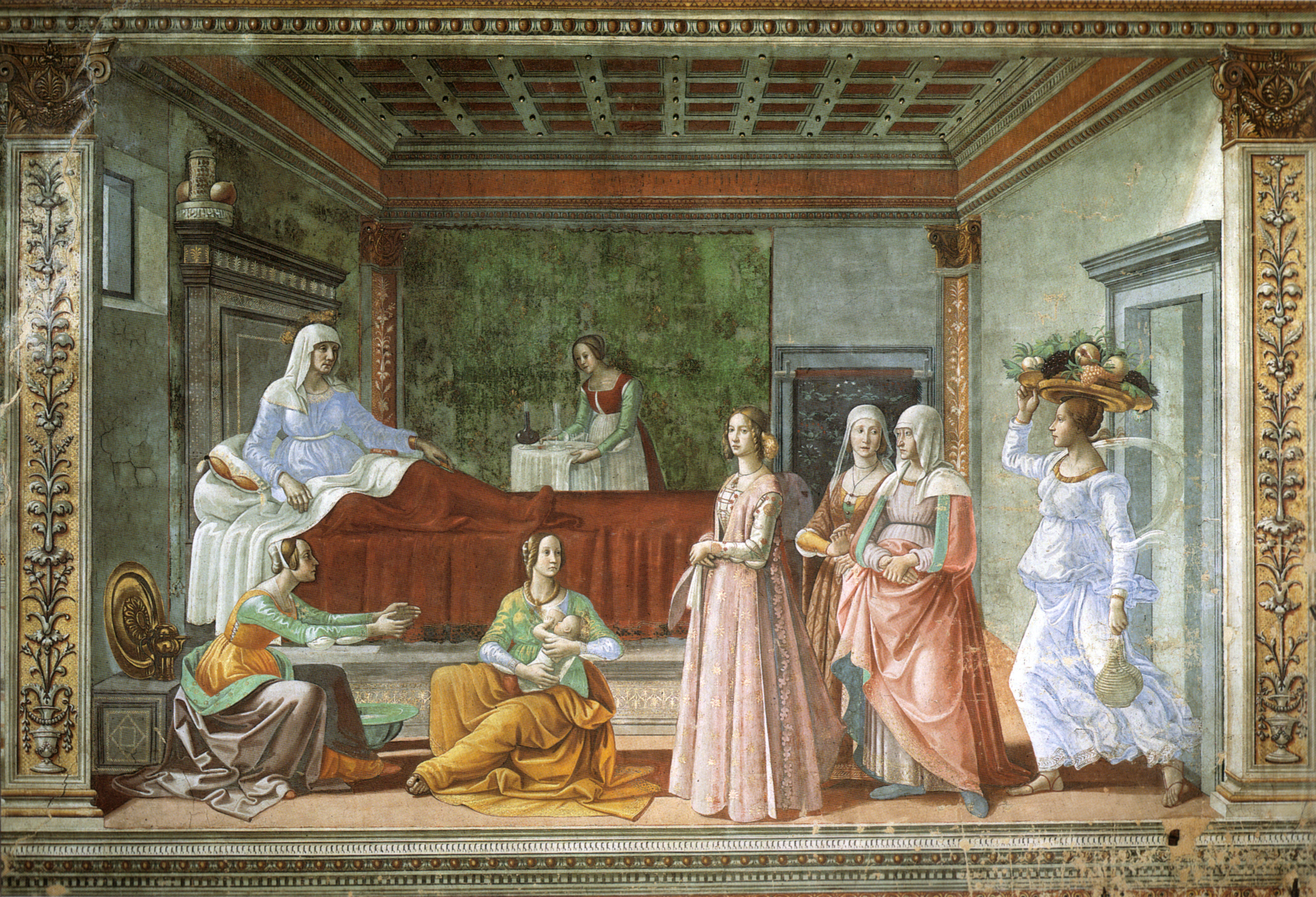
This is just a simple introduction to Renaissance fashion based on what I could gather from a few readings. I am not in the position (yet) to say whether Botticelli’s Venus portrays a real/ideal woman and if it has any connection with Florentine ladies’ look. So far I have not noticed many similarities. However, as the painting is said to celebrate a wedding, I shall be tackle this aspect further, examine bridal bodily display (accessories, dresses, hair) and consider whether they apply to Venus and Mars. I am now collecting some bibliography and I will update my blog as soon as I gain a better understanding of this new exciting topic. In the meantime any suggestions/thoughts/info will be highly appreciated…


Monday, February 21, 2011

London, Botticelli and Mr. Barker

Oohh feel like l haven’t blogged for ages, too bad! Been busy trying to make progress with my PhD but it’s about time I share my thoughts.  I just got back from London where I spent a week reading and researching, researching and reading. It was nice to leave Edinburgh and spend some time in the sunny English capital. Not that I had any time to enjoy the sun! (and anyway, can I call it sun??). Research took me to the British Library (my very first time there!), National Gallery/National Portrait Gallery Archives and (my favourite) National Art Library at the V&A.
The purpose of my study trip was to research Botticelli’s Venus and Mars, today at the National Gallery. I spent a lot of time reading about it in the past few months, what an emotion to see the painting right in front of me at the Gallery! As explained in previous posts some scholars have hypothesised a connection between the panel and the Vespucci: the wasps flying around Mars head have been considered a symbol of the family (Vespucci > vespa > wasp). Although this explanation is fascinating and totally reasonable, the provenance of the panel and the connection with the Vespucci has never been confirmed and this is what I was (am) trying to ascertain.
All is known about the painting refers to the time of its arrival in the UK in the second half on the nineteenth century. A London collector, Alexander Barker, bought it in Florence around 1858-60 and the panel constituted one of the many Botticellis Barker possessed (among the others the four cassoni panels illustrating the Story of Nastagio degli Onesti at the Museo del Prado in Madrid). When Barker died his collection was sold at Christie’s in 1874 and some of his works were purchased by the National Gallery of London.
Unfortunately not much has survived about Barker. He is often described as an obscure collector and very little is known about him, his activity and his travels to Florence. My questions are: where in Florence did he find Venus and Mars? Who sold it to him (private dealer, auction house..)? The British Library has a book published in 1852 called The Lions of Florence. This little book was meant to be used as a guide of Florentine studios, restorers, art dealers and galleries for those (British) amateurs interested in purchasing Old Masters paintings in the Italian city. The author points out some dealers and restorers where good quality pictures could be found “by enquiring and hunting for, in remote places, streets and corners, where an indefatigable picture hunter – if he does not mind running up and down stair-cases, disturbing the proprietors at their meal, or even in bed, and wading through oceans of rubbish – may discover perhaps a gem, and certainly some second rate painting of value, especially of the old Florentine school”. This is great but.. how do I find out more? Where can I find information about those picture dealers and what they owed? The amount of material that could be out there is daunting and the Lions made me realize that the panel could have really been anywhere. The Lions, just like other material consulted in London, gave me more clues than answers. Overall I am still positive, aware that this is just the beginning and a lot of work still has to be done.

Thursday, January 20, 2011

The project meets the audience…

The week in Florence ended with a postgraduate symposium held at the Monash University in Prato where I presented my research to a small audience.  The talk was very short but I had enough time to give a general  introduction on my project, outlining its aims and the research methodology.

The feedback was so positive! It was really interesting to get comments and suggestions from the audience (just like it is happening with this blog. A ‘thank you!’ to all the people that have emailed me over the past few months, every single contribution has been really precious). One question addressed to me after the presentation was on the connection Vespucci - religious sphere.  This question reinforced my idea (see previous post) of engaging with research about the family and the Florentine religious orders. Several hints in fact seem to be leading in this direction: the Umiliati active in Ognissanti; family members who were priests themselves; relation of some of the Vespucci with the Dominican order in Florence. Would this be useful to put into context the family patronage? Can't say more than a simple, and perhaps banal, maybe.

Touching the past

One of the most exciting moments of the study trip was entering the Archivio di Stato. How amazing! After the initial confusion where-to-go/what-to-do (my supervisor was with me and having her there made things sooo much easier..) my first archival experience was great (Oh yes, nearly forgot. The archive has hideous lockers, not a pleasant experience mine. Moments of pure terror when I accidentally messed up the combination..)
                                               Archivio di Stato, Florence (Google Images)

Lockers apart, the reading room is terrific. For all those people who think of archives as dusty old places..well, you are wrong! The Archivio di Stato is really modern inside (at least now, no idea how it was in the past) with shiny, new desks and strong desk lights.
With the help of my supervisor I ordered and viewed a document of the Catasto (tax forms) in which we found a document that belonged to the Vespucci (about 1440). It was great to have such an old paper in front of me although I was (and I still am) scared by the difficult handwriting. One of the things I will be doing in the next few months before going back is getting used to that type of handwriting and exercise with similar documents. The short but intense introduction to the Archive was really useful: I am now more confident about working in the building and I feel I will get the most out of it next time I’m there for research.

Wednesday, January 19, 2011

Two afternoons with the Vespucci

My first two afternoons in Florence last week have been really inspiring. I had the chance to meet  some members of the cultural association called “Comitato Amerigo Vespucci a casa sua” whom I’ve been in touch with by email from the UK. Not only I was invited to the presentation of their book I Quaderni Vespucciani, but one of the members also guided me around Borgo Ognissanti to see the Vespucci places (Ognissanti church and San Giovanni di Dio hospital)
The Comitato Amerigo Vespucci was founded a couple of years ago  by Florentine historians, geographers and amateurs with the purpose of promoting the figure of Amerigo Vespucci with a view to the celebrations of 2012 (500 years from Amerigo’s death). The society is variously involved in organizing conferences and cultural events in order to spread the knowledge of Amerigo, his travels and discoveries. This is also the aim of the Comitato’s publication I Quaderni Vespucciani.
On Tuesday I visited Ognissanti church in order to see the Vespucci chapel in flesh. Once there I also realized that there are numerous family tombs in the building: one is on the floor next to the chapel while the others are located along the transept of the church. They are all clearly recognizable as Vespucci tombs because they display the family coat of arms with golden wasps that appears (twice) also on the sides of the chapel. Just off the square where the church stands there is the 'Spedale San Giovanni di Dio founded in early 1400 by Simone Vespucci. Apparently the house of the early Vespucci became part of the 'Spedale (hospital) although today there is no trace of what the house looked like. We can only gather an idea from the following XIX century drawing that shows the entrance to the structure:
(Google images)

The sites were really interesting although none of the original settings of the house were visible. This confirms that research has to be carried out in archives in order to find out more about the family properties in Borgo Ognissanti. It will also be interesting to investigate the relation Vespucci-religious orders and their patronage in church related environments. Ognissanti church was connected to the order of the Umiliati. What was their relation (if any) with the Vespucci? We know that the family moved to Borgo Ognissanti at the beginning of the XIV century. Is it possible to establish some sort of connection between the family and the religious order since then?
                                  Vespucci tomb, Ognissanti Church (transept) Google images

Sunday, January 9, 2011

A week in Florence

Finally in Florence! The city is looking amazing in this time of the year, loads of people around (sales!) and Xmas decorations still on.  I am on a study trip with the University of Edinburgh that has organized an intensive Renaissance course in Florence.  Classes will take place in museums and archives in Florence as well as at the Monash University of Prato where symposiums and lectures have been planned for the week ahead.  You can find more information about the course here.
Classes apart, I will be taking some time to visit a couple of libraries and archives to start off my research. What I aim to do is collecting material related to the lineages of the family and gain an extensive knowledge on its genealogy and history.  

Wednesday, December 29, 2010

House or palace?

Before considering where the Vespucci art collection was kept and how it was displayed, I need to ask myself the following questions: where did the Vespucci live? Is it possible to locate the family palace in Florence today? Unfortunately these simple questions have no simple answers: apparently the family did not owed just a palace but several houses. This information complicates the research because investigations cannot focus on one site only but have to take into consideration both the palace and the houses. Working on different sites might also complicate the reconstruction of the family collection that, in all probability, was not kept in one place only but spread in the several properties. Ouch!
I managed to find information on the Vespucci houses on Internet. Browsing several websites I came across information relating the palace that used to belong to the Vespucci. The building still stands today in Florence (via dei Servi) and it is commonly known as Palazzo Incontri. The palace was sold to Giovanni Vespucci in 1499 and it appears to be the building in which, according to Vasari, Botticelli and Piero di Cosimo painted two rooms (see previous post, Friday 10 December 2010) The history of the building is well explained on the palace website: http://www.palazzoincontri.com/notiziein.htm. A valuable (although not academic) source is also the brief description available on Wikipedia: http://it.wikipedia.org/wiki/Palazzo_Incontri
                                                   Palazzo Incontri
Online I also came across the transcriptions of some documents of the Florentine Catasto related to the Vespucci family (http://e-prints.unifi.it/archive/00000583/01/Pagine_9-87.pdf) These documents, dated 1451-1515, show that by 1451 the family was living in the Ognissanti area, in the street called Via Nuova (today Via della Porcellana). Apparently the Vespucci family owed houses in that street before acquiring the palace in 1499.
While the Vespucci palace still stands today (although greatly modified by later construction works), less is known about the house(s) in Via della Porcellana. Are they still visible? It is known that in 1380 Simone di Piero Vespucci, who was living in that street, decided to open a hospital for the citizens and his house became part of the hospital today known as Spedale San Giovanni di Dio. Visiting the hospital in Florence would be a good starting point for my research.
Questions that come to mind are: how many houses did the Vespucci owed in Via delle Porcellane? How were they connected to the ‘Spedale? Did the family continue to live there after Giovanni Vespucci bought the palace? How were the family’s lineages grouped in the houses? Further research will hopefully shed light on these issues.