Sunday, October 23, 2011

Three weeks at the Library of Congress in Washington DC

My research time in Washington DC has reached its end and I am getting ready to fly back to the UK (between us, I am not ready to face Edinburgh rain yet). Time at the Library of Congress was extremely valuable and allowed me to collect a wide range of material about the Vespucci family.
Library of Congress, Washington DC. Entrance Hall

The documents consulted were only marginally useful to my research as they dealt with the involvement of the Vespucci in political aspects of the Florentine republic. Information about artistic related issues were scattered across the several folders and, unfortunately, none of them provide any answer. I however managed to gather together some potentially interesting clues that will need to be verified once in Florence.
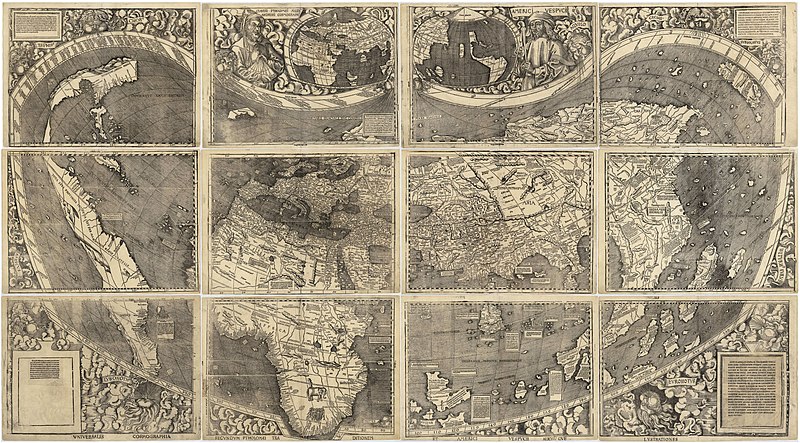
While at the Library of Congress, I took some time to explore the beautiful building and one of the must-see things on my list was the Waldseemuller Map of 1507. The map caught my curiosity while researching on Giorgio Antonio Vespucci (to read about him have a look at the entry posted on July 27th). A well-known humanist in Florence, Giorgio Antonio passed on his knowledge of classical languages to members of his own family, in particular the nephew Amerigo as some Latin exercise books once belonged to the navigator seem to confirm. Uncle and nephew must have also shared common interests in geographical discoveries. Initial research has in fact shown that Giorgio Antonio was not only an important point of reference for the spreading of classical culture but also for the circulation of maps, as he appears to have been involved with Renaissance cartographic production.  Studies on Giorgio Antonio’s manuscripts have highlighted the presence of maps and atlases, such as that of Ptolomy, in the humanist library and this, according to some, would confirm Giorgio Antonio’s interest in geographical discoveries and his possible connection with the Waldseemuller Map (on display at the Library of Congress, Jefferson Building).
LoC, Waldseemuller Map, 1507

The Waldseemuller Map is a printed wall map of the world created by the German cartographer Martin Waldseemüller and published in April 1507. The map is based on a modification of Ptolemy's map, expanded to accommodate the Americas. It is the first map to use the name "America" and a drawing of Amerigo Vespucci appears on the top right side. The peculiarity of the map is that it indicates the existence of a new ocean, the Pacific, even if the first records of Europeans sailing this ocean were recorded in 1512-13, a few years after Amerigo’s discoveries. The cartographer Waldseemuller was a member of the the church of Saint-Dié-des-Vosges which was protected by Renee II, Duke of Lorrain.  As the Duke studied in Florence under Giorgio Antonio Vespucci, earlier researches have pointed out the connection between Renee II, Waldseemuller and Giorgio Antonio and the possible exchange of geographical knowledge that might have occurred between them and that might have been brought to the creation of a map that anticipated later discoveries.  Attention to geographical questions was also paid by Florentine humanists as the circulation of maps, atlases and Geografie seem to have involved several intellectuals among which was Lorenzo di Pierfrancesco de Medici, pupil of Giorgio Antonio. 
It also curious to notice that next to the portrait of Amerigo Vespucci on the top of the map, there is a little insect that could be a wasp. As wasps also appear on the family’s coat of arms, this does not generate any surprise. This waspy element however seem to be recurrent in all the pictures today associated with the Vespucci and it starts to appear more and more as a proof-of-identity component. General consensus agrees that, in the past, people had a higher understanding of art works than the one we have today. They possessed tools and knowledge to easily understand the meaning and the symbology of a painting. I therefore wonder what a depiction of wasps would have come across as. Would have the viewer of Botticelli’s Venus and Mars, for instance, associated the presence of wasps to the Vespucci or would have those insects conveyed a different meaning? And were depictions of wasps recurrent in paintings? Umm, something to think about…
(for Botticelli’s Venus and Mars and its connection with the Vespucci family please see previous posts, in particular 22nd December 2010)

Sources (for full reference see the Bibliography page)
• Gallori Nencioni 1997               
• Gentile 1992
• Graziosi (Stretto di Benguela, online)
• Perini 1993
• Piani Baratono (Teofanie Cosmologiche, online)
• Verde 1973
• Woodward 2007

Tuesday, October 11, 2011

New year, new blog!

The second year of my PhD has started and holidays are only a nice but far image in my mind. Back to research, very exciting year ahead! As anticipated in my previous post I am in Washington DC where I will be spending 3 weeks researching at the Library of Congress. Before cracking on with some what-I-am-doing bla bla bla I'd like to point your attention to the new(ish) look of my blog!

The idea of enlarging this virtual space has been at the back of my mind for quite a while and I finally made room for some "extras". First of all there is a new "Search" bar that can be used for searching among the entries of this blog. I have also added a "Pages" bar you can move through: in the "Home" you'll find my research posts; the full reference of books, articles and websites cited will be listed in the "Bibliography"; the "Gallery" will act as a container for all the most relevant images discussed. You can still leave a comment below each entry but if you wish to get in touch by email contact details are listed in the "About me" page.

Looking forward to hearing what you think about this changes. This is still a work in progress and I suppose the layout of the blog will change as my research progresses. Any suggestions for further "pages" you readers would find handy?


Wednesday, September 28, 2011

Year II (already??)

Here I am at the end of my first PhD year and the very beginning of the second. This blog opened 365 days ago and at this time last year I started formulating questions about the Vespucci and their role as art patrons in Florence.

I feel I came a long way since I started and, at the same time, I have the impression I have not moved at all. On one side I learned a lot about Renaissance art & culture and all the readings have been extremely useful and interesting. I also attempted to advance some hypotheses on Venus and Mars and its relation with the Vespucci but lot of work still need to be done. On the other side I am aware I have no answers.

I reckon part of this 'uneasy' feeling is due to the fact that my research is archive-based. Readings are certainly important but, after a while, the first real step into the (scary) archive world needs to be done. And that moment has indeed arrived for me.

The exciting news I was referring to in my previous post has all to do with archival research. I am planning a 3 month trip around the globe to hunt down Vespucci related documents. Off to Washington DC soon (can't wait to step in the Library of Congress!) and Florence afterwards. Hopefully this time will be really valuable and productive! Regular updates will be on this page.

PS. Oh yes, I have passed my 1st year PhD review last week ;)


Monday, September 19, 2011

Summer research break

Oohh, just realized I have not blogged for a while! But I have good reasons (or excuses?) for it.
Spent all August writing a 10.000 words doc to sum up the outcomes of my 1st year research. It was really interesting to go back and revise all the material collected. Did not realize I had SO much references! At that point, I was so grateful to all those people (Steve in particular, big thank you) who recommended to use a reference manager at the beginning of my PhD (and thank you to Cristiano for setting it up). Although writing that paper was an unbelievably painful process, pulling material/thoughts together was extremely useful to recap where I was and figure out which direction I wanted my project to take.

I also made use of August to start learning some paleography basics. As I am soon going to do some Vespucci document hunting in archives, I thought it was about time to engage with fifteenth century documents and get use to the language and the writing stlyle. As soon as I started I felt the need of crying! Things are slowly getting better now although I am still far from reading an entire document by myself. My supervisor Jill Burke gave me tips and support and it was really helpful (and less depressing) to get through that material with someone who knows her stuff.  After all that hard work I treated myself to two weeks holiday in lovely Malta, so good to escape Edinburgh rain & wind (and insane festival tourists!).

Here I am now, ready to give a 30mins presentation on Wed 21st at uni for my 1st year PhD Review. I will go back to my research after that and start from where I left. Lots of exciting news and trips coming up in Autumn/Winter time, will soon blog about them all.

If you can, keep your fingers crossed on Wed :)

Wednesday, July 27, 2011

Giorgio Antonio Vespucci and the intellectual circles in Laurentian Florence

Following my previous post that investigated the possibility of interpreting Venus and Mars according to Neoplatonic ideas, I am now going to consider the activity of a humanist who gathered around Ficino and who was part of the Vespucci family, Giorgio Antonio. According to the documentation gathered so far, he was member of the most important cultural circles in Florence and he established, through his activity as a humanist, fruitful relationship with European courts such as those of Loren and Hungary. Information about Giorgio Antonio are today scattered across very different sources and, in order to fully understand this personality, I had to consider a various range of material that included religious writings, philological and cartographic studies.
Giorgio Antonio (1434-1514) was born into a well-to-do family. Son of Amerigo Vespucci and brother of Bartolomeo Maria and S’Anastagio (the dad of Amerigo the navigator-explorer), Giorgio Antonio lived in Borgo Ognissanti where he shared a house with the nephew Giovanni, son of Bartolomeo. Giorgio Antonio has been identified with one of the male figures that appear in Ghirlandaio’s portrait in the Vespucci chapel. Overcoming previous hypotheses, the Florentine historian Marco Conti has recently advanced a new identification of the figures represented in the Madonna della Misericordia. Conti identifies the twelve characters with members of  Amerigo the explorer’s family and suggests Giorgio Antonio to be the fourth male on the right side of the Virgin. The presence of the humanist in the painting might support those hypotheses that want Giorgio Antonio patron of Botticelli's S. Agostino in Ognissanti.
Giorgio Antonio has been studied especially for his role as a humanist, his activity as scribe and his employment as a teacher of Greek. The Vespucci brothers were a family of scribes and Giorgio Antonio, together with Ser Nastagio collaborated on copying manuscripts for the family library. They also did some copying for payment which allowed them to establish connections with families and relevant personalities in and outside Florence: Giorgio Antonio had contacts with the Hungarian humanist Petrus Garazda in the late 1460s; and Nastagio copied a Statius with the arms of King Corvinus which was decorated in Hungary. After the death of Ser Nastagio the writings were taken over by Giorgio Antonio who formed a notable collection of books, both manuscript and printed. Some of these were bequeathed to the Cathedral – of which Giorgio Antonio became Canon in 1480 - and to Ognissanti. The majority however was donated in 1499 to the convent of San Marco where Vespucci was appointed priest and became friend of Savonarola.
The convent of San Marco and his library formed one of the most important centers of humanistic and literary studies in Florence. The bibliophile Niccolo' Niccoli collected several manuscripts and wanted, at his death, his collection to be transformed into a public library. Cosimo de Medici gathered Niccoli’s books and created in San Marco the first library of modern times that rotated around the Medici’s patronage. The centre benefited not only from the books and manuscripts donated by Niccoli but also from those given by Cosimo de Medici and Giorgio Antonio who became one of the most important benefactors of San Marco. The Vespucci and his activity as scribe have recently caught some academic interest and a list of the manuscripts he possessed was drawn. One hundred forty-nine books have been so far identified although old inventories, like the one by San Domenico di Fiesole, reported the existence of one hundred and eighty manuscripts. The ones so far identified can be divided into two major sections: Latin and Greek, the former more numerous than the latter. Manuscripts and books than belonged to Vespucci are today easily recognisable due to their specific features: some bear the family coats of arms with four golden wasps; some the sign of Ognissanti, the family church; other that of the Arte della Lana of which some of the Vespucci were members. Some manuscripts also bear a note of possession “Georgii Antonii Vespuccii liber” followed by the name of those who the use of the book was extended to.
Scholarly attention has not only been given to the manuscripts Giorgio Antonio possessed but also to some philological aspects relating his knowledge of Greek and Latin. Recent studies suggested that Vespucci self-learned Greek and Latin information that seems to be confirmed by a letter that he sent to the Dominician brother Giovanni from the Badia of Settimo. In his writing Vespucci talked about his experience in copying Greek and Latin manuscripts and admitted that he had not reached a perfect level in neither. Despite his judgment, Vespucci’s knowledge of classical languages must have been reasonably good as he taught in one of Florence’s universities, the Studio Fiorentino. Not many information about Giorgio Antonio’s activity at the Studio have survived but it is known that he taught Latin and Greek. Indirect sources provided names of some of his pupils: Antonio Lanfredini, Piero and Giovan Vittorio Soderini, Alamanno Donati, Dionysius Reuchlin and Renee II, Duke of Loren. It has been noticed that several pupils of Giorgio Antonio were also taught by Ficino who was strictly connected to Vespucci through the several activities they were both involved in. A close friendship seems to have linked Ficino and Vespucci: Ficino asked Giorgio Antonio to check his translation of Plato’s writings and from in his letters appear the high consideration he had of Vespucci as a humanist. They shared interests in classical writings, Christian religion, astrology and the universe. Ficino died in the arms of Vespucci.
Ficino and Vespucci’s friendship can be related to sphere of the Medici patronage and, in particular, to their activity for the Compagnia de’ Magi, the Platonic Academy and the Studio Fiorentino. Studies on fifteenth century confraternities have highlighted the presence of Giorgio Antonio in the Compagnia de’ Magi, a lay group that, engaging with many devotional activities, had an important role in Florence’s religious life. Members of the Compagnia such as Donato Acciaiuoli, Cristoforo Landino, Pier Filippo Pandolfini and Giorgio Antonio Vespucci, produced sermons that have been said to reflect Ficino’s Platonic ideas although there is actually no proof that Ficino belonged to the group. Some of them - Vespucci included - were however a member of the Academy and of the Studio Fiorentino were Ficinian ideas must have circulated. Through these groups Giorgio Antonio established contacts with some of the predominant intellectuals of Laurentian Florence as all these activities were under the Medici patronage: the Medici took a hand in the Compagnia’s affairs, transforming the annual celebration of the Magi across the streets of Florence in an occasion of self-celebration; the Studio was said to be ‘thing’ of Lorenzo; and the Accademia was founded by Cosimo.
Although investigation are not concluded, there is enough evidence to believe that Giorgio Antonio played an important role in sharing Neoplatonic ideas through his activity at the Studio Fiorentino where some of those philosophical theories were formulated. The involvement of Giorgio Antonio in the Studio, the Accademia and the Compagnia suggests not only the importance the Vespucci family gained in the city but also the support it received from the Medici, having those three humanistic and religious circles benefited of the Magnifico’s confidence. The activity of Giorgio Antonio as a humanist can therefore be linked to the intellectual ‘climate’ of the time in which other personalities related to the Medici patronage - such as Landino, Poliziano, Ficino and Acciaiuoli - gravitated. The participation of Giorgio Antonio in these Medici-led humanistic gatherings, his employment as a tutor of  Lorenzo de Medici and the involvement of other Vespuccis in the Medici’s affair  (such as Amerigo who became one of the Medici’s property administrator) proves how the Ognissanti family interacted with the Medici on different levels.
It is also interesting to notice the ‘circular’ path the research took. Starting from Venus and Mars, considered a Vespucci commission due to the presence of wasps on the right corner, investigation considered a possible Neoplatonic interpretation of the panel. And by considering Ficino and the humanists of Laurentian Florence, the research returned to the Vespucci family by analysing the activity of Giorgio Antonio and, in particular, his friendship with Ficino and the Medici.
Sources
Birnbaum, D. M. 1973. “An Unknown Latin Poem probably by Petrus Garazda, Hungarian Humanist”, Viator (University of California, Centre of Medieval and Renaissance Studies. Los Angeles, University of California Press)
Conti, Marco. 2010. “Nuove attribuzioni per la Madonna della Misericordia”, I Navigatori Toscani. Quaderni Vespucciani (Firenze, Firenze Libri): 280.
Davies, J. 1992. “Marsilio Ficino: Lecturer at the Studio Fiorentino”, Renaissance Quarterly, 45: 785-790
De la Mare, A. 1985. “New Research on Humanistic Scribes in Florence”, Miniatura Fiorentina del Rinascimento 1440-1525. Un primo censimento (Firenze, Giunta Regionale Toscana & La Nuova Italia Editrice)
Denis, G. 2006. Piero di Cosimo: Visions Beautiful and Strange (Yale University Press)

Gallori, F. & Nencioni. 1997. S.”I libri greci e latini dello scrittoio e biblioteca di Giovanni Antonio Vespucci. Introduzione e Catalogo”, Memorie Domenicane, 28: 155-359
Gori, P. 1898. “L'affresco del Ghirlandaio e il Ritratto di Amerigo Vespucci nella Chiesa di Ognissanti”, I centenary del 1898. Toscanelli-Vespucci-Savoranarola. Firenze nel secolo XV. Feste, Giuochi, Spettacoli (Firenze, Tipografia Galletti e Cocci)
Hankins, J. 1991. “The Myth of the Platonic Academy of Florence”, Renaissance Quarterly, 44: 429-475
Hatfield, R. 1970. “The Compagnia de' Magi”, Journal of the Warburg and Courtauld Institutes, 33: 107-161
Ullman, B. & Stadter, P. 1972. The public library of Renaissance Florence. Niccolo' Nicoli, Cosimo de' Medici and the library of San Marco (Padova, Editrice Antenore)
Ventrone, P. 1992. Le Tems Revient ‘l tempo si rinuova. Feste e spettacoli nella Firenze di Lorenzo il Magnifico. Firenze, Palazzo Medici Riccardi 8 Aprile-30 Giugno 1992(Milano, Silvana Editoriale)
Verde, A. 1973. Lo Studio Fiorentino: 1473-1503 : ricerche e documenti (Firenze, L.S. Olschki)

Friday, July 8, 2011

Venus and Mars: love, sleep and drugs in a Neoplatonic interpretation.

I have the feeling is about time to move away from aspects of material culture and start considering the meaning of Venus and Mars in relation to the context in which this painting was conceived. Botticelli’s works have been variously interpreted according to the Neoplatonic ideas that flourished in fifteenth century Florence. Do these ideas apply to Venus and Mars too? What meaning is the painting trying to convey? I took into consideration elements I had not taken into account previously and focused on aspects relating to ideas of love, the role of sleep and the use of drugs in Renaissance Italy.
Neoplatonism and the concept of love
In the cultural life of fifteenth century Florence a leading role was played by Marsilio Ficino who tried to disseminate Platonism through his Academy, seen as one of the greatest achievements of Medici patronage.
Born in 1433, Ficino received his education in Florence, pursuing studies in the humanities, philosophy and medicine although he does not seem to have obtained an academic degree. Trained in the classical languages and literature, he knew Greek and Latin and had an extensive knowledge of ancient philosophy. Ficino cultivated several literary genres such as the treatise, the dialogue, the oration and the letter, and corresponded with many humanists of his time in Italy and beyond. He was a close friend of the Medici family: tutor of Lorenzo, in 1462 benefited from the house in Careggi that Cosimo de Medici gave him. Cosimo placed here several Greek manuscripts at Ficino’s disposal and this is regarded as the period when the Platonic Academy was founded.
The Academy was not an organized society with rules and a programme of study. It was instead a group of friends and disciples who gathered around Marsilio Ficino and who were bound together by a common interest in his teaching and by the friendship and patronage of the Medici. The activities of the Academy were closely linked with Ficino himself: conversations with friends, banquets and discussions. Ficino’s sources included writings of Plato but also those attributed to Hermes Trismegistus, Zoroaster, Orpheus and Pythagoras. He was also influenced by Epicureanism of Lucretius and attended course in Aristotelian philosophy at the University of Florence.
Ficino’s ideas uncovered several themes: universe, immortality of the soul, human love, conception of religion and its relationship to philosophy. His conception of contemplation in particular is the key to understand his ideas about Love through which Venus and Mars might be explained. Contemplation is a direct spiritual experience during which “the soul withdraws from the body and from all external things into its own self and there it discovers not only its divinity but the intelligible world, the transcendent ideas, and god himself” (Kristeller 1980).
It has been noticed that this separation of the soul from the body was not a mere metaphor. Ficino conceived it as a sort of ecstasy, a magical flight he believed people could really attain during their life. This mystical experience man could go through was achieved through what Ficino called “furors” such as poetry, prophecy and, among others, love. The latter was defined by the philosopher as the desire for beauty and was viewed as a force that could lead men towards god (Tomlinson 1993).  
                                                    
Marsilio Ficino (Florence)

Sleep and drugs
The representation of Mars in Venus and Mars recently caught my attention and has turned out to be a very interesting element. The god is lying on the opposite side of Venus; he is naked and asleep. The contrast between the awake goddess and the asleep god has been previously taken as the key element to uncover the meaning of the panel: Love is stronger than War and wins everything. The theme of love is certainly appropriate to interpret the panel according to the Neoplatonic ideas of fifteenth century Florence. But as Venus and Mars seems to have been enriched with Neoplatonic meanings – just like other Botticelli’s works - is it possible that Mars aims at conveying a stronger message than the one of the defeated god? In order to answer this question I’ve turned my attention to the idea of sleep in Renaissance culture and how this was viewed according to the Neoplatonism.

Sleep was valued in the Renaissance because of its divinatory powers and the prophetic nature of dreams: while dreaming men were closer to God. Sleep was moreover associated with love seen as a spiritual journey of ascension from physical desire to spiritual contemplation and ecstatic connection to heaven initiated by the sight of beauty. The possibility of communion was premised on the lover’s ability to overcome his physical desire and direct his attention toward the higher forms of love and beauty present in his beloved. This idea, as explained above, was also promoted by the Neoplatonism as Ficino viewed sleep as a state in which the soul is free from the constraints of the body and can therefore communicate with the divine (Ruvoldt 2004).
But there is more. A recent study on Venus and Mars was published by David Bellingham who noted that near Mars, on the right-hand corner of the panel, there is a small satyr who holds a peculiar fruit under his hand. Bellingham recognized in the fruit the Datura Stramonium, a plant also known as "poor man's acid" that can produce hallucinations with effects similar to LSD. Why would have Botticelli painted that? I wonder if this has some link to the idea of sleep and contemplation. Ancient Greek used to drink wine in order to reach a higher state that made them closer to God. Also, in fifteenth century Florence Savonarola employed metaphors of drunkenness to express the union of the soul with God. Were drugs used for the same purpose? Is it possible that drugs were employed to reach a higher contemplative state or to attain one of Ficino’s “magical flights”?
Satyr and the Datura Stramonium fruit under his hand
Ficino’s ideas emphasize a strict connection between sleep-contemplation-love-beauty. I wonder if such connection is visually expressed in Venus and Mars. Mars, the male ideal dreamer, is in a contemplative state that makes his soul ascending from the body to spiritual levels. What allows him to achieve this is the “furor” of love initiated by beauty (Venus): through contemplation the god can overcome his physical desire and move his attention towards higher forms of (divine) love. Contemplation and vacatio might be made easier through the use of datura stramonium – though I don’t want to stress this point too far due to scarce evidence and knowledge.
As stated in my previous posts, investigations in material culture seem to support the hypothesis of Venus and Mars as a wedding commission. Would a Neoplatonic message – evolving around ideas of love-contemplation-divine - be appropriate for a marriage piece? It is difficult to ascertain whether a specific iconographic/philosophical programme was drawn behind Venus and Mars due to a lack of original documents and for the complex, multi-layered interpretations offered by the panel. There is no doubt however of Botticelli being influenced by the Neoplatonic ideas developed by Ficino and the group of Florentine humanists the painter was connected to by ties of friendship and patronage.
Sources
• Ficino, M. 1987. El libro dell’amore (Firenze, Leo S. Olschki Editore)
• Hawkins, J. 1991. “The Myth of the Platonic Academy of Florence”, Renaissance Quarterly, 44: 429-475
• Kristeller, P.O. 1965. Eight philosophers of the Italian Renaissance (London, Chatto & Windus)
• Kristeller, P.O. 1980. Renaissance thought and the arts. Collected essays (Princeton, Princeton Uni Press)
• Nesca, R. 1935. Neoplatonism of the Italian Renaissance (London, George Allen \& Unwin LTD)
• Ruvoldt, M. 2004. The Italian Renaissance Imagery of Inspiration. Methapors of sex, sleep and dreams (Cambridge, Cambridge University Press)
• Tomlinson, G. 1993. Music in Renaissance Magic (Chicago and London, The University of Chicago Press)
• D.Bellingham’s article is available online: http://www.npr.org/documents/2010/june/botticelli

Wednesday, June 29, 2011

Simonetta Vespucci between real and ideal

Venus from Venus and Mars has often been associated with Simonetta Vespucci (nee Cattaneo), considered one of the most beautiful women of Renaissance Florence. Originally from Genova, Simonetta married Marco Vespucci and moved to Florence where she was admired by poets and painters who tried to immortalize her beauty in poems and paintings. Over the years that of Simonetta became a myth and several attempts have been made to identify the real portrait of the real Simonetta. Fingers had been pointed towards the following: Verrocchio’s female bust (National Gallery of Art, Washington DC); Piero di Cosimo’s portrait of young lady (Musee Conde’, Chantilly) and many Botticelli’s female portraits. But can any of these works be taken as the real representation of Simonetta?


Recent scholarship have tackled this issue noticing how difficult is for us to confirm whether these images actually refer to a specific woman. As these portraits share striking similarities (figures’ hair, dresses and facial features), it is possible that they were meant to represent a particular lady that physically existed in fifteenth century Florence. In Venus and Mars the contemporaneity of the painting is suggested by those aspects of material culture that I have previously analised (brooch and cushion). Contemporary elements apart, these artworks also seem to trasform the (real) female figure into an ideal one based on Petrarch’s poetic stereotypes.

Botticelli’s ladies are characterized by long wavy blond hair, dressed with light, long white tunics that show their bare feet. These elements recall classical examples, associating Botticelli’s figures to nymphs and goddesses. The same “transformation” happens in poems by Petrarch, Angelo Poliziano and Lorenzo il Magnifico where ladies are described with long blond hair, rose cheeks and red lips. They are also said to be chaste and graceful (gentil/leggiadra). Images of nymphs and mythological allusions often occur in poems, according to the themes of the Dolce Stil Novo and, perhaps, due to the Neoplatonic influences. Correspondences between poetic works and painted images clearly appear.

Botticelli’s female portraits therefore become part of the “problematic category of Renaissance paintings identified as portraits of unknown beautiful women” (Schmitter; Cropper). Both these portrait-like images from Botticelli's workshop and the poems written about Simonetta combine representations of 'real'/'ideal', 'portrait'/'nymph' creating complex, multi layered figures and meanings.
The desire of capturing/finding Simonetta’s beauty persists nowadays. The Italian artist Omar Ronda chose to depict and compare the myth of Simonetta Vespucci with that of Marilyn Monroe. A recent exhibition in Florence (2010) brought together a selection of Ronda’s Frozen Portraits representing Simonetta (or what we think is the portrait of Simonetta) and Marilyn: two different women, belonging to two different times who shared one feature, beauty.


Sources

• Lazzi, Giovanna e Ventrone, P. 2007. Simonetta Vespucci: la nascita della Venere fiorentina (Firenze, Polistampa)

• Lazzi, Giovanna e Santaniello, F. 2010. Omar Ronda: Metamorfosi di Primavera
(Milano, Skira)

• Cropper, Elizabeth. 1986. “The beauty of women: problems in the rhetoric of Renaissance portraiture”, Rewriting the renaissance: the discourse of sexual difference in early modern Europe (Chicago University Press)

• Schmitter, M. 1995. “Botticelli’s images of Simonetta Vespucci”, The Rutgers Art Review, 15: 33-57

• Interesting blog about Simonetta Vespucci (in French and Italian): http://simonetta-vespucci.blogspot.com/