Sunday, May 6, 2012

Beyond boundaries: translatability of cultures and visual arts in fifteenth century Florence


Most of us would agree with the description of European museums given by Mary Sheriff: sequential rooms dedicated to different national schools at different historical moments. We find the common chronological division Middle Ages/early Italian Renaissance/Baroque on one level while the Islamic, Chinese and Latin America arts located on a different floor - if not in an entirely different building (Sheriff 2010). This problematic aspect of display finds a parallel in the way the arts tend to be studied: great attention is paid to individual masters, national developments and local patronage.

Since the ‘50s cultural studies have been trying to overcome this strict classification by focusing on cultural transfer and cultural exchange. In 1949 Fernand Braudel discussed in his book Mediterranean the importance of "cultural frontiers" stressing the idea of us/them, the encountering of the other, and the symbolic boundaries that resist mapping. Later on cultural historians turned to the study of material culture – especially food, clothes, art – showing how these elements reveal cultural codes and identity (Burke 2004). The study of cultural transfer therefore moves towards a theory of cultural hybridity, sharpening awareness and sensitising people to the necessity of cultural variety (Roeck 2007. Farago 2010).

Europe is indeed rich in its cultural variety, consisting of countries different one from the other on many levels. Nevertheless Europe is also highly cosmopolitan due to its diverse countries linked through webs of political, economic, religious, and social ties (Belozerskaya 2002). Cultural encounters between these distinct identities generated cultural translation/cultural exchange that encompassed several domains from language and religion to cuisine, fashion and the arts (Burke 2004). In the past few years numerous studies have been devoted to the interaction and exchange between European countries and, in art history, this led to a reconsideration of the Renaissance in the light of the interaction occurred between Italy and – to mention some – the Netherlands, Russia, the Balkan and Asia (see contributes in Roodenburg 2007). Transfer and globalism have also constituted the topic of recent academic conferences world-wide such as Harvard’s Ornament as Portable Culture. Between globalism a locatism; Edinburgh’s From Influence to Translation: Art of the Global Middle Ages; and London forthcoming Fashioningthe Early Modern at the Victoria and Albert Museum. 

When exploring interaction between different entities it is necessary to take into account encounters on a larger scale such as those between Europe and the New World in the age of discovery. Scholarly output tried to elucidate and explore the dynamic processes that influenced European artist’s creativity and that, consequently, shaped the visual arts after 1492 (Sheriff 2010. Farago 2010). While it is easier to recognize mutual exchanges between Europe and Latin America (or Asia) from mid-sixteenth century onwards, exchange “practices” in late fifteenth century are still hazy. However some considerations can still be drawn regarding Florentine art.

Piero di Cosimo’s series of panels said to represent the “early history of man” (The Hunt; The Return from the Hunt; The Forest Fire; the stories of Vulcan) share common features, representing fights, wild men and primitive scenes (Figure 1). Speculations have been made on whether a possible connection could be established between these panels and the geographical discoveries undertook in the fifteenth century by navigators such as Columbus, Amerigo Vespucci and Paolo Toscanelli (Brown 2010; Geronimous 2006). Explorers’ travel accounts and letters (of which illustrated editions appeared, Figure 2) were in fact enriched with the descriptions of alien lands, savages and barbaric episodes. Could have these written text influenced the imagination of Florentine patrons and artists? Positive answer. Bellicose, primitive scenes, monstrous animals and mythical figures such as tritons, satyrs and centaurs can be found not only in Piero di Cosimo’s panels but also elsewhere in Florence: in the frieze decorating Scala’s urban villa in Borgo Pinti; in the painted architecture of Botticelli’s Calumny of Apelles; and in Giuliano da Sangallo’s decorative frieze design for a fireplace executed for Giuliano Gondi; (Geronimous 2006. Meltzoff 1987).

Figure 1. Piero di Cosimo, A Hunting Scene (NY, Met)

Figure 2. Woodcut from A.Vespucci Mundus Novus (1505)

It seems therefore plausible to link the primitive (negative?) depictions that circulated in the last decade of the century to the fights and invasions related to the geographical discoveries.  The presence of these images however makes us wonder if, and to what extent, these representations could also be connected to the unbalancing changes Florence was experiencing locally at the time: the Medici exile; Savonarola’s apocalyptic preaching (Weinstein 1970); and the descent of Charles VIII. In the last decade of the century wild men, fauns and satyrs appeared in pageants across the city (Pieri 1988) while in ad outside Florence people started to fear what was defined as mostro (beyond Florence “disturbing” images and performances took place in Venice where later on, from 1500, representations depicted hell populated by devil-like presences. See Aikema 2001). The use of this word is recorded in connection to Charles VIII, seen more as a monster than a man (Niccoli 1990), and to the birth of baby-monsters (Bec 1988). When seen in the light of Florence’s historical circumstances, these examples may help to understand why the proliferation of savages and monster-like images found some fertile ground in the Tuscan city and, more generally, in Italy. Political events, apocalyptic prophecies, geographical discoveries and encounters with the Other contributed to shape Florentines’ imaginary world and the arts. Artists assimilated new ideas and transported them in re-adopted classical modes of expression (fauns, centaurs) embodied with new social meanings based in the life of the present (Dempsey 2012).

Thursday, March 8, 2012

And more...

For those who happen to be in Florence, interesting conference. Don't miss out!

Wednesday, February 22, 2012

And so the celebration began…

This morning, in the sunniest day Florentines had in weeks, the celebration in honour of Amerigo Vespucci - and the Anno Vespucciano - officially kicked off. Made sure I had time for a quick breakfast before and while enjoying coffee & jam croissant I found an article about Amerigo Vespucci in one of the national newspapers. At 9.15 a service was celebrated in the church of Ognissanti. The small number of people that turned up (probably the only who managed to get up on time!) was slightly disappointing but contributed to create a very intimate atmosphere. Over the mass the navigator and his family were remembered several times especially in the priest’s sermon centred on ideas of fame, faith and dust (men like Amerigo, who left an imprint in the world’s history, became important thanks to their cleverness and their faith in God. It does not matter how famous one is during his life, we must remain humble and remember that we were dust, and dust we will be again).


After the service everybody (big crowd waiting outside the church) gathered on the square in front of Ognissanti for the speeches or Florence’s mayor, the president of the “Comitato Amerigo Vespucci a Casa Sua” and Sarah Morrison the US Consul General. The programme of Florence’s initiatives planned for 2012, designed to mark the relationships between Florence and the New World, was briefly explained (will post more about this!). The audience comprised Florence’s citizens, representatives of the town hall and various associations, and members the Marines dressed head-to-toe. It was a feast of music, words, laughs and coloured flags. 


The morning ended in the courtyard of the ex-Vespucci hospital, the Ospedale San Giovanni di Dio, where official pictures were taken and a lot of hands shaking was done. A horde of people kept coming and going, welcomed in the building by three gorgeous girls dressed up as fifteenth century ladies (clearly inspired by images of Simonetta Vespucci and, possibly, Botticelli’s three Graces. But that is just my personal bet). The Visconti, a Florence-based company famous for the production of writing tools, presented their new limited edition pen bearing a geographic pattern inspired by the Waldsemuller Map. Managed to get a free (well, hopefully free) Visconti metal bookmark and also fell in love with the most amazing-looking tie I ever seen. This friendly American man, who I started chatting to, was wearing a white silk(ish) tie filled in with blue question marks and a red sentence at the bottom “Who named America?”. A bit cheesy someone might argue but definitely fun and spot on. Loved it and secretly wanted it.


Tuesday, February 14, 2012

2012, Florence and the Vespucci celebration

Last year Florence’s mayor Matteo Renzi announced that 2012 was going be the year dedicated to the 500 years of the death of Amerigo Vespucci, the Florentine explorer who, in the fifteenth century, sailed the Atlantic and reached the coasts of America that was named after him.
The city has an interesting calendar of activities lined up aiming at exploring the strong links Florence-New Continent from the fifteenth century up to nowadays. One of the forthcoming event is the exhibition Americani a Firenze. Sargent e gli impressionisti del Nuovo Mondo (Americans in Florence. Sargent and the impressionists of the New World) scheduled from March 3rd to July 15th at Palazzo Strozzi.

For those who happen to be in Florence next week a couple of appointments are worth mentioning. On Monday 20th the “Comitato Amerigo Vespucci a Casa Sua” will held a conference on the Tuscans navigators – specific focus on Amerigo Vespucci - at Villa il Ventaglio (details below). The “Comitato” is active in Florence and surroundings to promote the study and research on Amerigo’s life and travels. Interesting articles have recently appeared in the group’s publications “Quaderni Vespucciani. I Navigatori Toscani” (the number 4 has just been issued) that can be found at the Libreria de’Servi (via de’Servi, Florence)


Celebration will continue on Wednesday 22nd in Ognissanti, the original “hub” of the Vespucci family since the thirteenth century, where the annual speeches/music band performance will be carried out in honour of Amerigo (details below)


Enjoy!

Monday, December 12, 2011

New hypothesis on the Vespucci chapel in Ognissanti and Ghirlandaio’s frescoes

When entering the church of Ognissanti visitors are bound to stop in front of the second chapel on the right side of the nave, the Vespucci’s. Years after the first few family members moved to Borgo Ognissanti, the Vespucci started to extend their power and patronage to the nearby church of Ognissanti, at the time under the control of the Humiliati.

The family chapel is decorated by two frescoes of Domenico Ghirlandaio: the Deposition and, right above it, the Madonna della Misericordia. The peculiarity of the latter are twelve kneeling figures depicted underneath the Virgin’s robe that brought art historians to speculate on who they portray. The possibility of one of them being the famous navigator-explorer Amerigo made the depiction a worthwhile topic of research. For years the dating of Ghirlandaio’s painting and the identification of its figures has been widely discussed and several hypotheses have been advanced. A recent publication by Karl Schlebusch (Schlebusch 2009) have pulled together previous considerations and re-examined them under the light of new documents, offering an insight into the construction of the chapel, its decoration and the relation with the Vespucci family.


Gathering documents from the Archivio di Stato of Florence and the archives of the Cloister of San Domenico in Fiesole, Schlebusch was able to find a terminus post quem for the beginning of the chapel’s construction works. The first reference to the chapel dates 1472 when Amerigo the Elder (the explorer’s grandfather) and his sons met up with Ognissanti’s monks to arrange the construction of a family chapel. Amerigo did not see the building finished as his testament records the will of having his sons in charge of building the chapel “della misericordia.

The chapel is mentioned again in 1473 when Amerigo’s three sons Nastagio, Bartolomeo, and Giorgio Antonio met up with the Capitolo of Ognissanti. They decided to change the location of the family chapel within the church, wished the chapel to be modelled after the one of the Merchants guild in the church of San Pier Scheraggio and agreed in the project to be finished within ten years.

In a further document dated 1480, Giorgio Antonio (see previous posts for his predominant role in Florence) agreed with the Capitolo to pay 100 florins for a lifelong use of the burial space. The chapel is referred to as “already built” and the document also mentions Nastagio, Giorgio Antonio and the deceased Bartolomeo as patrons. The chapel must have been almost completed by the time Bartolomeo died in July 1479. On the basis of this founding, Schlebusch was able to date the chapel between 1474 and 1479 as the new documents provided the most accurate dating indication so far known.

A fairly precise dating of the chapel also has consequences on the dating of Ghirlandaio’s frescoes. According to the documents, it was not until the end of 1473 that it was decided where the chapel had to be placed. This leads to assume that Ghirlandaio cannot have started earlier than 1474. Furthermore, it is known that the artist was not in Florence from September 1474 till May 1474 and it seems reasonable to believe the painter started working on the Vespucci chapel after his return to Florence. The frescoes could therefore be dated around 1476-77.

The manuscripts found gave Schlebusch the opportunity to re-examine the identification of the figures portrayed in Ghirlandaio’s frescoes. By considering the tax reports of the Florentine catasto and taking into account dating aspect, the historian concluded that the twelve people depicted represent members of Amerigo’s family (Amerigo the explorer).

The two figures in the middle, with their backs towards the beholder, resemble a married couple and, in all probability, they represent Amerigo the Elder and his wife Nanna. The two people at the far right and left are Nastagio and his wife Lisa Mini. Bartolomeo is placed between Amerigo and the Bishop, and his wife Maria on the opposite site. The other two men are Giorgio Antonio, never married, and Jacopo, portrayed as an eighteen-year-old boy. The last three women are respectively Piera, Margherita and Verdiana, Amerigo’s (the explorer) aunts. Among the group of people depicted around Christ in the Deposition, Schlebusch identify the man dressed in dark clothing, who stares at the beholder, with Saint Anastasius Persa. He could just as well represent Amerigo’s father, who was also called Nastagio.


Schlebusch’s exposé offers a new(ish) insight into the construction phases of the chapel and Vespucci patronage rights. The writing provides interesting material but while presenting facts and “data” it misses out on the opportunity to tackle the social, historical and artistic context that surrounds the chapel, the church and – most importantly – the Vespucci. Although the inclusion of original Latin documents at the end of the article makes it easier to follow the author’s argument, there is to hope that these considerations - not only on chapel itself but also on the activity of Ghirlandaio - would be sooner or later published in English and spread among a wider audience. Otherwise we would all better get a really good German dictionary (at least I would).

A big Thank You to Klazina for her invaluable help with the translation of the article. Also, Thank You to the friends who stopped by and offered help at the library. And Thank You to those who have started making fun of my non-existent German by dropping German words into our conversations.

Source
Karl Schlebusch. 2009. “Neue Dokumente zur Vespucci-Kapelle in Ognissanti und zur Familie Domenico Ghirlandaios”, Mitteilungen des Kunsthistorischen Institute in Florenz, 2/3: 364-374.

Sunday, December 4, 2011

From DC to Florence

I feel the urge of writing a quick post after having received several comments such as "you'd better write something on your blog, was ages since your last entry". Well, fair enough. It has been ages and although I have good excuses for this, they all look very weak at the moment.

From DC to Florence. I am getting to spend two months researching in what is probably my favourite Italian city and things are going rather well. I am trying to collect as much as possible and check all the hints found at the Library of Congress. Trotting from archives to libraries trying to look and copy a large amount of material has left me with barely any time to organize the sources and, therefore, barely any ideas for blog entries.

Studying in Florence and dedicating myself full-time to research is making me re-think the whole project and is making me reconsider the approach I want to use. Being in Italy is also extremely useful to locate Vespucci-related publications I had not encountered before. This is the case of an extremely interesting article on the family chapel in Ognissanti I recently came across. It's taking me some time to translate this paper (German, argh!) but it will soon (yes people, soon!) be the object of my next post.

Sunday, October 23, 2011

Three weeks at the Library of Congress in Washington DC

My research time in Washington DC has reached its end and I am getting ready to fly back to the UK (between us, I am not ready to face Edinburgh rain yet). Time at the Library of Congress was extremely valuable and allowed me to collect a wide range of material about the Vespucci family.
Library of Congress, Washington DC. Entrance Hall

The documents consulted were only marginally useful to my research as they dealt with the involvement of the Vespucci in political aspects of the Florentine republic. Information about artistic related issues were scattered across the several folders and, unfortunately, none of them provide any answer. I however managed to gather together some potentially interesting clues that will need to be verified once in Florence.
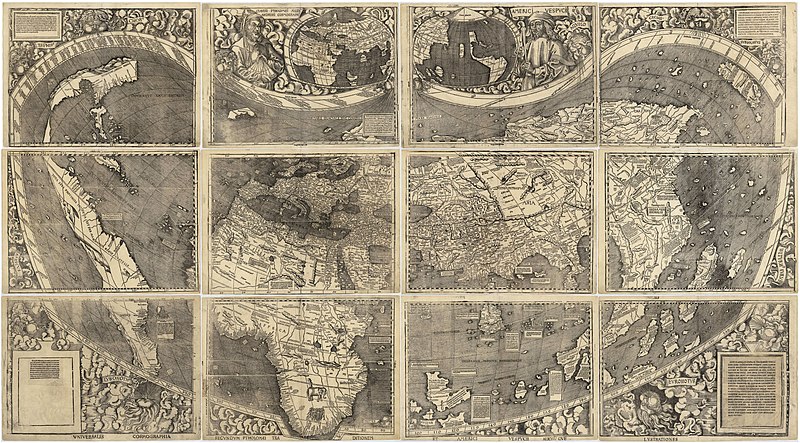
While at the Library of Congress, I took some time to explore the beautiful building and one of the must-see things on my list was the Waldseemuller Map of 1507. The map caught my curiosity while researching on Giorgio Antonio Vespucci (to read about him have a look at the entry posted on July 27th). A well-known humanist in Florence, Giorgio Antonio passed on his knowledge of classical languages to members of his own family, in particular the nephew Amerigo as some Latin exercise books once belonged to the navigator seem to confirm. Uncle and nephew must have also shared common interests in geographical discoveries. Initial research has in fact shown that Giorgio Antonio was not only an important point of reference for the spreading of classical culture but also for the circulation of maps, as he appears to have been involved with Renaissance cartographic production.  Studies on Giorgio Antonio’s manuscripts have highlighted the presence of maps and atlases, such as that of Ptolomy, in the humanist library and this, according to some, would confirm Giorgio Antonio’s interest in geographical discoveries and his possible connection with the Waldseemuller Map (on display at the Library of Congress, Jefferson Building).
LoC, Waldseemuller Map, 1507

The Waldseemuller Map is a printed wall map of the world created by the German cartographer Martin Waldseemüller and published in April 1507. The map is based on a modification of Ptolemy's map, expanded to accommodate the Americas. It is the first map to use the name "America" and a drawing of Amerigo Vespucci appears on the top right side. The peculiarity of the map is that it indicates the existence of a new ocean, the Pacific, even if the first records of Europeans sailing this ocean were recorded in 1512-13, a few years after Amerigo’s discoveries. The cartographer Waldseemuller was a member of the the church of Saint-Dié-des-Vosges which was protected by Renee II, Duke of Lorrain.  As the Duke studied in Florence under Giorgio Antonio Vespucci, earlier researches have pointed out the connection between Renee II, Waldseemuller and Giorgio Antonio and the possible exchange of geographical knowledge that might have occurred between them and that might have been brought to the creation of a map that anticipated later discoveries.  Attention to geographical questions was also paid by Florentine humanists as the circulation of maps, atlases and Geografie seem to have involved several intellectuals among which was Lorenzo di Pierfrancesco de Medici, pupil of Giorgio Antonio. 
It also curious to notice that next to the portrait of Amerigo Vespucci on the top of the map, there is a little insect that could be a wasp. As wasps also appear on the family’s coat of arms, this does not generate any surprise. This waspy element however seem to be recurrent in all the pictures today associated with the Vespucci and it starts to appear more and more as a proof-of-identity component. General consensus agrees that, in the past, people had a higher understanding of art works than the one we have today. They possessed tools and knowledge to easily understand the meaning and the symbology of a painting. I therefore wonder what a depiction of wasps would have come across as. Would have the viewer of Botticelli’s Venus and Mars, for instance, associated the presence of wasps to the Vespucci or would have those insects conveyed a different meaning? And were depictions of wasps recurrent in paintings? Umm, something to think about…
(for Botticelli’s Venus and Mars and its connection with the Vespucci family please see previous posts, in particular 22nd December 2010)

Sources (for full reference see the Bibliography page)
• Gallori Nencioni 1997               
• Gentile 1992
• Graziosi (Stretto di Benguela, online)
• Perini 1993
• Piani Baratono (Teofanie Cosmologiche, online)
• Verde 1973
• Woodward 2007